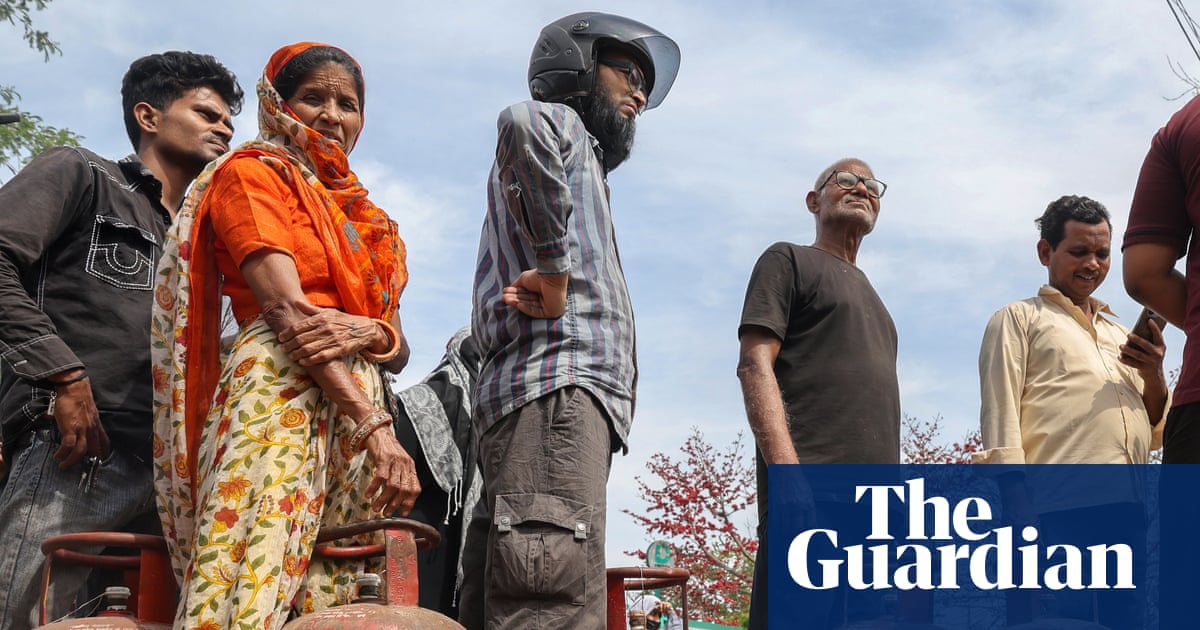
Maya Rani has been queuing for four days, her six-month-old daughter in her arms, hoping to secure a cooking gas cylinder in Delhi. Each day she returns home empty-handed, told to return the following week. Her husband’s attempt to refill their 5kg cylinder at a local refiller also failed. there was no gas available.
Rani’s struggle is being replicated across India, as a disruption to liquefied petroleum gas (LPG) supplies, triggered by the closure of the Strait of Hormuz amid the escalating conflict in Iran, has created the country’s worst gas crisis in decades. The crisis is impacting households and businesses alike, with prices surging and operations being scaled back or shut down entirely.
“I feel like crying,” Rani said, sitting on the pavement outside the gas distributor’s office, trying to soothe her child. “We have been waiting for days and still don’t know when we will get gas.” Her husband’s work prevents him from joining the daily queue, leaving Rani to navigate the process alone. “We are eating just one meal a day from outside. I’ve had to ask neighbours to help boil milk for my baby.”
The closure of the Strait of Hormuz, a vital maritime route for global energy supplies, has severed a critical artery for India, which imports approximately 60% of its LPG, with 90% of those imports passing through the strait. Only two LPG cargoes have arrived in India since the strait’s closure, a fraction of the country’s daily demand.
Akhtar Malik, of the Bureau of Research on Industry and Economic Fundamentals in Delhi, emphasized that the vulnerability of the Strait of Hormuz has been “extensively studied and debated for years.” However, he added, “India built strategic crude oil reserves but did not create equivalent buffers for LPG.” While global standards recommend 40 to 60 days of reserve cover for critical fuels, India currently maintains just over 20 days of LPG storage.
The impact is being felt acutely in the restaurant industry. Nandu Kishore, manager at Shawaya House in Delhi, reported having to drastically reduce his menu. “We have 30 items on the menu, but we’re selling no more than six,” he said. “Even those are only possible because we’ve started using coal.” With Eid al-Fitr approaching, a traditionally busy period for restaurants, the situation is particularly concerning.
The crisis extends beyond the food service sector. In Morbi, Gujarat, a major tile manufacturing hub, nearly 450 of 670 ceramic units have suspended operations, with another 430 factories planning to follow suit for at least three weeks. Shahidul Alam, a worker at a closed factory in Morbi, was waiting at a railway station to return to his home in West Bengal. “The manager told us the factory is shutting and we won’t be paid,” he said. “We were already struggling to get cooking gas here. Without work, People can’t survive – how will we eat?”
Reports indicate a rise in thefts targeting trucks carrying LPG cylinders as supplies dwindle. Households are increasingly turning to electric cooking, with retailers reporting a tenfold increase in demand for induction burners in cities like Delhi. Ajay Mandal, a construction worker, expressed relief after receiving a meal at a government-subsidised canteen that had been temporarily closed due to the gas shortage. “If this crisis worsens, many poor people will proceed hungry,” he said, adding that he had resorted to collecting firewood to cook for his family. He noted the price of a gas cylinder has soared from around 900 rupees to 4,000 rupees on the black market, while the cost of a simple roadside meal has doubled.
The Indian government has directed refineries to maximize LPG production for household use and prioritize supplies for essential services like hospitals and educational institutions. However, the long-term implications of the supply disruption remain uncertain.
Leave a Reply