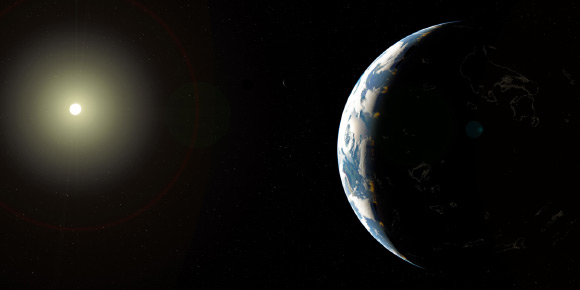
Astronomers have identified 45 rocky exoplanets within the habitable zones of their stars, offering a prioritized list for the search for extraterrestrial life. The research, published today in the Monthly Notices of the Royal Astronomical Society, also highlights 24 worlds within a more conservative “3D habitable zone,” factoring in stricter limits on planetary heat retention.
The study, led by Cornell University’s Professor Lisa Kaltenegger and her colleagues, leverages data from the European Space Agency’s Gaia mission and the NASA Exoplanet Archive to empirically define habitable zones. “Several successful ground- and space-based searches have increased the number of known exoplanets to over 6,000,” Kaltenegger and her team wrote. “An underexplored aspect of these discoveries is that the growing number of exoplanets allows observers to build a target list that can probe the limits of the habitable zone empirically.”
The identified planets include well-known candidates like Proxima Centauri b, TRAPPIST-1f, and Kepler-186f, alongside less-studied worlds such as TOI-715b. The TRAPPIST-1 system, located 40 light-years from Earth, is particularly noteworthy, with planets TRAPPIST-1d, e, f, and g included on the list. LHS 1140 b, 48 light-years away, also appears as a promising target. The potential for liquid water on these planets hinges on their ability to retain an atmosphere.
Planets receiving stellar radiation comparable to Earth’s include TRAPPIST-1e, TOI-715b, Kepler-1652b, Kepler-442b, Kepler-1544b, Proxima Centauri b, Gliese 1061d, Gliese 1002b, and Wolf 1069b. The latter group are detected through the “wobble” they induce in their host stars.
Researchers also focused on planets near the edges of the habitable zone to test current assumptions about its boundaries. “While the idea of the habitable zone has been developed since the 1970s, new observations will be critical in establishing whether certain assumptions need adapting,” Kaltenegger stated.
The study also considers the impact of elliptical orbits on planetary habitability. Worlds like K2-239d, TOI-700e, and K2-3d, as well as Wolf 1061c and Gliese 1061c, experience varying heat levels due to their orbital paths. TRAPPIST-1g, Kepler-441b, and Gliese 1002c are positioned at the outer edge of habitability, where temperatures are extremely low.
Gillis Lowry, a graduate student at San Francisco State University and a co-author of the study, emphasized the practical application of the research. “While it’s hard to say what makes something more likely to have life, identifying where to appear is the first key step — so the goal of our project was to say, Here are the best targets for observation.”
The team’s catalog is intended to guide future observations with instruments like the James Webb Space Telescope, the Nancy Grace Roman Space Telescope, the Extremely Large Telescope, the Habitable Worlds Observatory, and the proposed Large Interferometer For Exoplanets (LIFE) project. “Observing these small exoplanets is the only way to confirm if they have atmospheres, and whether astronomers need to refine their ideas of what limits the habitable zone,” Lowry said.
According to the NASA Exoplanet Archive, as of March 19, 2026, 6,150 planets have been confirmed, including 762 discovered by the Transiting Exoplanet Survey Satellite (TESS). TESS launched in April 2018 and continues to survey the sky for transiting exoplanets around nearby stars. The archive also lists 7,913 TESS project candidates as of March 13, 2026.