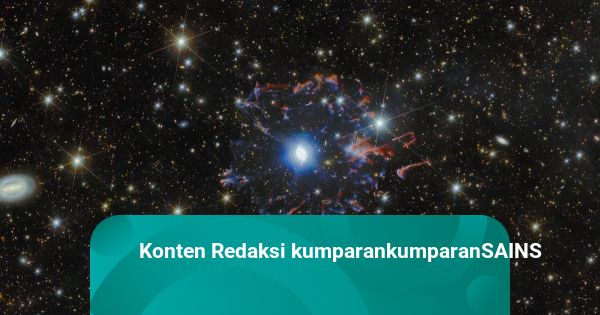
A newly combined image from the NASA/ESA Hubble Space Telescope and the European Space Agency’s Euclid telescope reveals the intricate layers of the Cat’s Eye Nebula, also known as NGC 6543, located approximately 4,300 light-years away in the constellation Draco. The image, released on March 3, 2026, showcases the nebula’s complex structure, formed as a dying star sheds its outer layers.
The Cat’s Eye Nebula is a planetary nebula, a phenomenon occurring when a low-to-medium mass star reaches the end of its life. Unlike massive stars that end in supernova explosions, these stars gently release their outer layers into space, creating expanding shells of gas. The nebula first revealed its gaseous nature in 1864 through spectral analysis, distinguishing it from stars and galaxies.
Euclid’s wide-field view captures faint arcs and filaments surrounding the brighter central region of the nebula, structures scientists believe represent earlier phases of the star’s death, preceding the ejection of the material that forms the main nebula. Hubble, with its high resolution, focuses on the nebula’s core, revealing the dying star surrounded by white bubbles and blue gas loops.
The Hubble observations, utilizing the Advanced Camera for Surveys, highlight complex gas bubbles, intricate filaments and jets of high-speed gas. These features are considered a “fossil record” of the star’s mass-loss events as it approached its final stages. Concentric rings within a brown halo mark the boundaries of these expelled gas shells.
The image also reveals high-energy gas jets emanating from the nebula’s top and bottom, interacting with slower-moving material to create dense knots of gas. These shock-induced knots and the concentric shells demonstrate the complex morphology of planetary nebulae, a discovery significantly advanced by Hubble’s detailed imaging in 1995.
The combined data from Hubble and Euclid provides a comprehensive view of the Cat’s Eye Nebula, illustrating the final chapter in the life of a star.