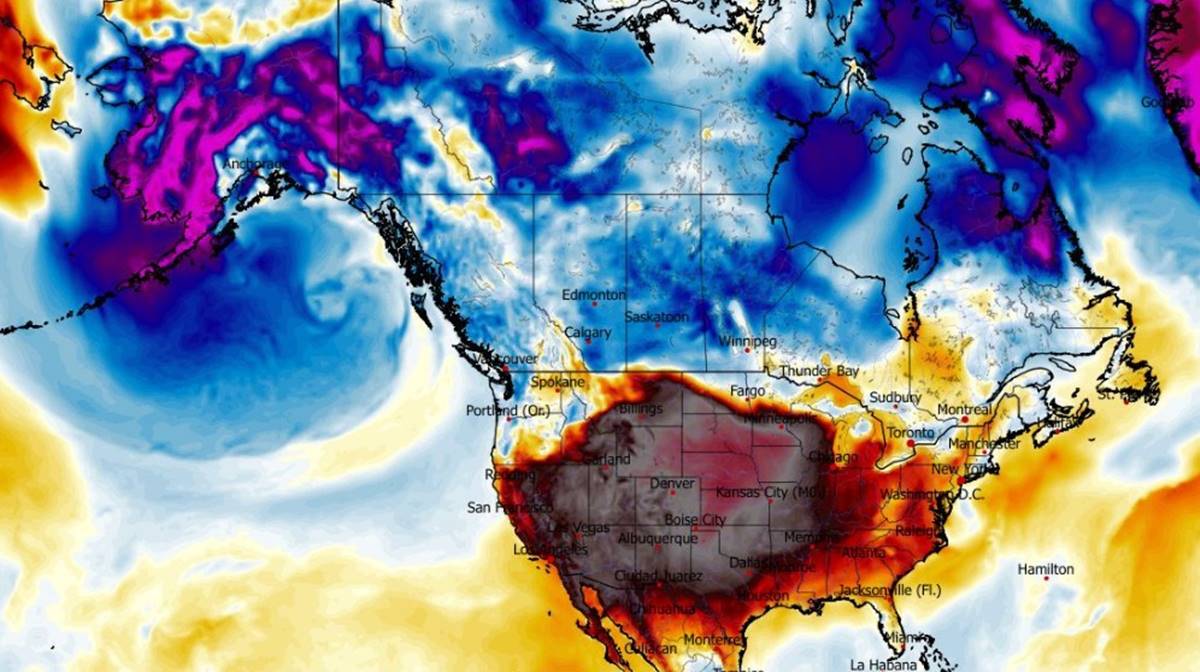
Unseasonable warmth has gripped parts of North America, with temperatures soaring to levels more typical of summer than March, while Europe experiences a late-season cold snap. Several areas across the United States and Canada are reporting temperature anomalies exceeding 20°C above average for this time of year, prompting concerns about the increasing frequency of extreme weather events.
The most significant temperature spikes are currently being observed in the interior of California, Nevada and Arizona, where temperatures are reaching 40-43°C. Phoenix, Arizona, recorded 41°C, while Los Angeles reached approximately 32°C. These temperatures are exceptionally high for March, even for a region known for its arid climate.
The unusual warmth is forecast to extend further north on Saturday, March 21st, impacting regions including Minnesota, Iowa, Missouri, and Arkansas. Forecasts indicate temperatures could be 22-24°C above average, translating to temperatures 24°C higher than typically experienced during this period. This expansion of heat is described as an exceptional event for the season, highlighting a significant disruption in the usual atmospheric patterns over the Northern Hemisphere.
Meteorologists attribute the current conditions to a strong subtropical high-pressure system pushing warm air masses from lower latitudes northward. This “heat dome” traps warm air in the lower atmosphere, leading to a further increase in ground temperatures. The phenomenon is linked to fluctuations in the polar jet stream, which when strongly undulating, creates pathways for warm air to surge northward and cold air to descend southward.
The current situation presents a stark contrast between Europe, which is experiencing a return to winter-like conditions with cold easterly currents, and North America, which is under the influence of a powerful anticyclonic crest. This dynamic is too potentially influenced by the stratospheric final warming, a process that can destabilize the polar vortex and contribute to blocked weather patterns and pronounced temperature anomalies.
Experts emphasize the role of climate change in amplifying these extreme weather events. Rising global temperatures increase the likelihood and intensity of anomalous heat waves, particularly when atmospheric conditions are conducive to their formation. While similar events have occurred in North America in the past, their frequency and intensity appear to be increasing, with potential impacts on ecosystems, agriculture, and water resource management.
In June 2025, Italy experienced a similar early heatwave, with temperatures reaching 40°C, as reported by Meteo.it. This event, linked to a broader pattern of rising temperatures across Europe and the United States, underscored the growing threat of extreme heat events globally. The Italian heatwave was characterized by an Extreme Forecast Index (EFI) value approaching +1, indicating a highly unusual thermal anomaly.
The United States has already seen signs of this trend, with reports in June 2025 of roadways buckling and deforming due to the intense heat, leading to numerous traffic incidents in states like Wisconsin and Missouri. The National Weather Service issued extreme heat and humidity alerts across the country, particularly in central and eastern regions.
Leave a Reply