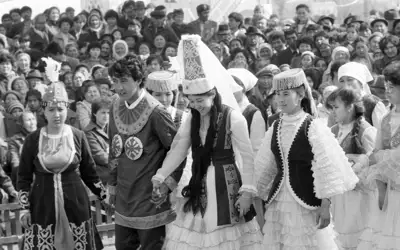
ALMATY – Kazakhstan is marking 38 years since the revival of Nauryz, the ancient spring festival that was suppressed for over six decades under Soviet rule. Celebrations began on Friday, March 21st, with events across the country commemorating the holiday’s return to public life in 1988.
Nauryz, a tradition rooted in the culture of Turkic peoples and stretching back over 3,000 years, celebrates the arrival of spring and the beginning of a new year. Soviet authorities banned the holiday in 1926 as part of a broader effort to suppress religious and traditional cultural practices, though many families continued to observe it privately.
The initial public re-emergence of Nauryz occurred during the period of perestroika, a restructuring of the Soviet system that allowed for greater openness and discussion of national traditions. Eleusiz Zhanpeisuly, then head of Almaty’s culture department, played a key role in organizing the first modern Nauryz celebration in the city. According to Zhanpeisuly, the initiative stemmed from Kazakhstan’s intellectual community, beginning with discussions at the Writers’ Union and advocacy from poet Mukhtar Shakhanov and ethnographer Toktasin Umirzakov.
Zhanpeisuly received an official order in 1988 from Zhibek Amirkhanova, deputy chairwoman of the Almaty Executive Committee, to organize a Nauryz celebration within the Frunze district. Support from within the Communist Party was likewise crucial; Uzbekali Zhanibekov, the ideological secretary of the Central Committee of Kazakhstan, explained the cultural significance of Nauryz to Gennady Kolbin, the first secretary, who then authorized the event.
The initial celebrations were limited in scope. In 1988, Nauryz events were permitted in only one district of Almaty, as well as in the Zhambyl district of the Almaty Region and the Shieli district of the Kyzylorda Region. The first Almaty celebration took place in Gorky Park, now the Central Park of Culture and Leisure, and featured recreations of traditional nomadic life. Organizers erected yurts, installed altybakan swings, and created spaces for traditional national games. Students and volunteers assisted in preparing the park, planting trees and cleaning irrigation channels, and banners displayed traditional Kazakh proverbs.
The festival included the serving of Nauryz kozhe, a traditional festive dish, which quickly ran out due to unexpectedly high attendance. Elders offered blessings, young people participated in traditional games, and performers presented folk music, poetry, and theatrical scenes based on Kazakh legends. The event was structured as a symbolic nomadic caravan procession, with the park divided into zones dedicated to games, children’s activities, poetry competitions, and performances. A performance depicting the struggle between winter and spring opened the celebration, followed by a procession led by a snail symbol towards the Abai monument, accompanied by music and dancing.
Aubakir Rakhimov, the event director, recalled a poignant moment during the celebration, witnessing Amirkhanova, the deputy chairwoman, with tears in her eyes saying, “Finally we have returned our Nauryz.” This sentiment underscored the historical significance of the event for many participants.
Following the success of the 1988 celebration, Nauryz events expanded across Kazakhstan in 1989, though authorities continued to impose restrictions. In 1991, the Kazakh Soviet Socialist Republic officially recognized March 22 as Nauryz Day, establishing it as a national holiday. After Kazakhstan gained independence, the celebrations grew significantly, becoming a three-day public holiday by 2001.
In 2010, the United Nations General Assembly declared March 21 the International Day of Nauryz, recognizing the holiday as part of the cultural heritage of many nations across Eurasia. More recently, in 2021, President Kassym-Jomart Tokayev proposed expanding the celebration into a broader Nauryznama period from March 14 to 23, incorporating additional cultural traditions like Korisu (Amal Day) and a Day of National Clothing. Today, Nauryz is celebrated throughout Kazakhstan with large public festivals, concerts, traditional games, and cultural events.
Leave a Reply