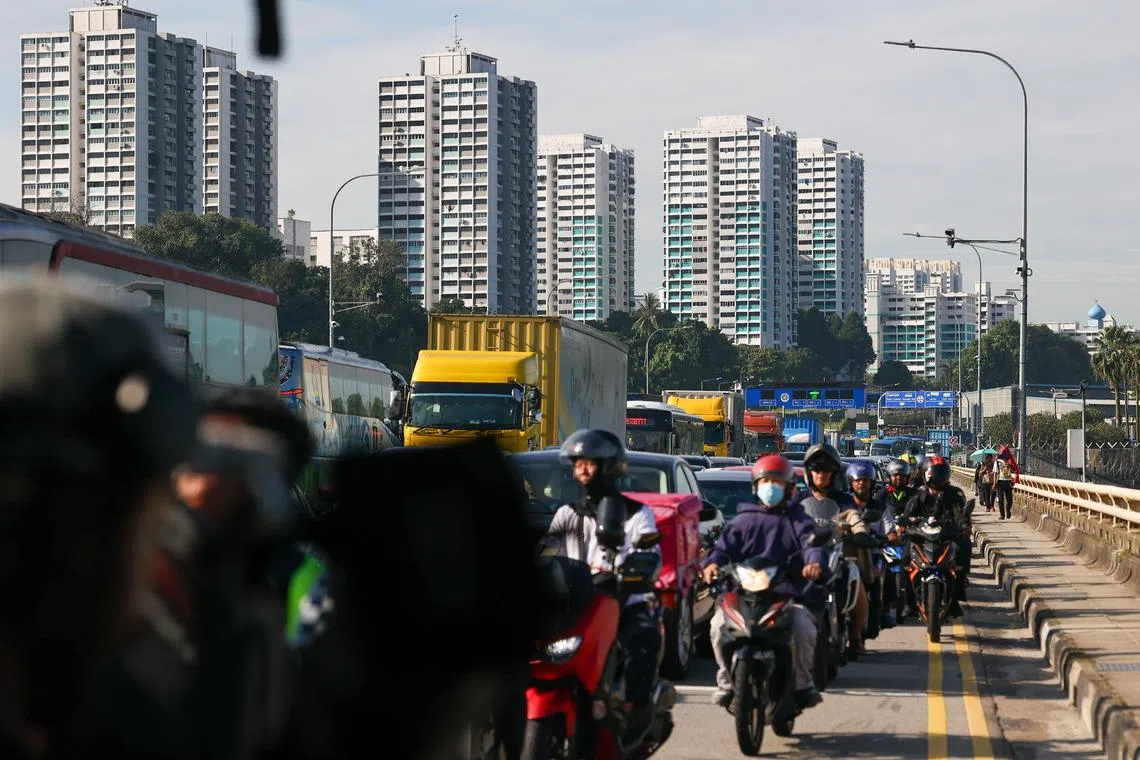
JOHOR BAHRU – Every week, Muhammad Fariezatul Ahmed, a social worker, crosses the Causeway from Johor Bahru into Singapore on his motorcycle, not to commute to a job, but to assist Malaysians injured in road accidents. These are often fellow motorcyclists making the daily journey for better employment opportunities. He frequently encounters individuals unaware of their insurance coverage, inadequately insured, or entirely without protection for their cross-border commute. “It’s a worrying trend. We receive calls for help almost every day… Every month, at least one person dies on the way to work or on the way home. When they gain into an accident, they don’t recognize what to do,” said the 35-year-old, who works with the Singapore Accident Help Centre (SAHC) in Johor.
A new insurance scheme aimed at addressing this vulnerability is slated to launch in Malaysia, specifically designed to cover its citizens working in Singapore during their daily commute – a long-standing gap in protection. Announced on February 5th by Human Resources Minister R. Ramanan, the proposed Traveller Scheme (Skim Pengembara) intends to insure the approximately 400,000 Malaysians who travel daily between Johor and Singapore, extending coverage beyond their working hours. Authorities are currently reviewing relevant laws to align with international labour standards, with the scheme expected to be operational by the second quarter of 2026.
The need for such a scheme is underscored by the sheer volume of cross-border traffic. Singapore estimates that between 300,000 and 400,000 people pass through its two land checkpoints daily, making the Causeway one of the world’s busiest land crossings. In 2024, approximately 77,000 foreign-registered vehicles entered Singapore daily, with motorcycles accounting for 82 per cent of that total. However, this commute carries significant risk. SAHC recorded 48 deaths in 2024 and 54 in 2025 resulting from accidents involving Malaysian workers travelling to and from Singapore, based on the cases they handled.
Workers express cautious optimism about the proposed scheme. Izzat Rozali, 36, who commutes from Gelang Patah to Tuas for work, already holds personal accident and life insurance in Malaysia. Nevertheless, he welcomes the initiative. “I think the new insurance scheme is something like what we have in Malaysia, something like SOCSO,” he said, referencing the Malaysian government’s Social Security Organisation. “I support it, but it’s still too early to see how it will be implemented.” SOCSO, or Perkeso, provides social security protection for employees against workplace injuries, diseases, accidents, and death, funded by monthly contributions from both employers and employees.
Nathan Krishna, 40, who commutes daily from Iskandar Puteri to Changi for work at an aircraft engineering firm, highlighted the current lack of clarity regarding existing coverage. “They don’t know the limits of coverage provided by their employers, and may not have their own insurance,” he said, suggesting the new scheme will provide at least a basic level of protection for commuting workers.
Motorists have identified several high-risk zones during peak hours, including the Causeway, Second Link, SLE, BKE, and AYE. Within the Johor Bahru district, the Eastern Dispersal Link and Pasir Gudang Highway are similarly recognized as accident-prone stretches. Wilson Lee, a port operator in Johor, noted, “Apart from being poorly maintained, these roads are frequently congested and see a massive presence of heavy vehicles, which makes it risky for motorcyclists.”
The issue stems, in part, from the fragmented nature of cross-border protection. In Singapore, employers of work permit and S Pass holders are required to provide medical insurance coverage with a minimum annual claim limit of $60,000. However, Singapore’s Work Injury Compensation Act (WICA) generally does not cover accidents occurring during commutes in personal vehicles or on public transport, as this is not considered to be “in the course of employment.” Financial advisor Carlos Lee explained that this leaves many workers exposed. “Generally, workers are not covered for their commute to and from work,” he said. “But some employers may want to better protect their workers by purchasing an extension on the existing plans for their employee that covers the journey to and from work.”
This creates a “grey area” for cross-border workers, particularly when accidents occur outside of Singapore or beyond working hours, according to Janey Wong, chief operating officer of SAHC. “Many cases we hear of, they get caught in an accident (in Singapore) and the immediate reaction is to want to proceed home… They are afraid that the hospital bills in Singapore will be more expensive,” she said. The case of Loqman Hussen, 26, a kitchen assistant in Tuas, illustrates this challenge. Injured on March 10th while riding from Gelang Patah to work, he suffered a broken ankle and collarbone after clearing Malaysian immigration but before entering Singapore. Treated at Hospital Sultanah Aminah in Johor Bahru, he received two months of medical leave, but his employer’s insurance did not cover the accident, and his Malaysian hospital leave was not recognized for paid leave. “I don’t have personal accident insurance, and my company’s plan covers only treatment in Singapore,” he said, adding he fears losing his job.
Syed Hussain Syed Husman, president of the Malaysian Employers Federation, told The Straits Times that workers often rely too heavily on employer-provided benefits, which are limited in scope and geography. “incidents that occur outside the workplace, particularly during the commute between Malaysia and Singapore, may fall into a ‘grey area’ where coverage is unclear or insufficient,” he noted. The proposed Malaysian scheme could help bridge this gap, potentially mirroring elements of SOCSO.
However, key details regarding the Traveller Scheme remain unclear, including funding mechanisms, contribution structures, and the level of coverage it will provide. Wong emphasized the importance of clarity to ensure workers understand their protection. “What are the limits and extent of the coverage offered by the scheme?” she asked, a question that remains unanswered.
Leave a Reply