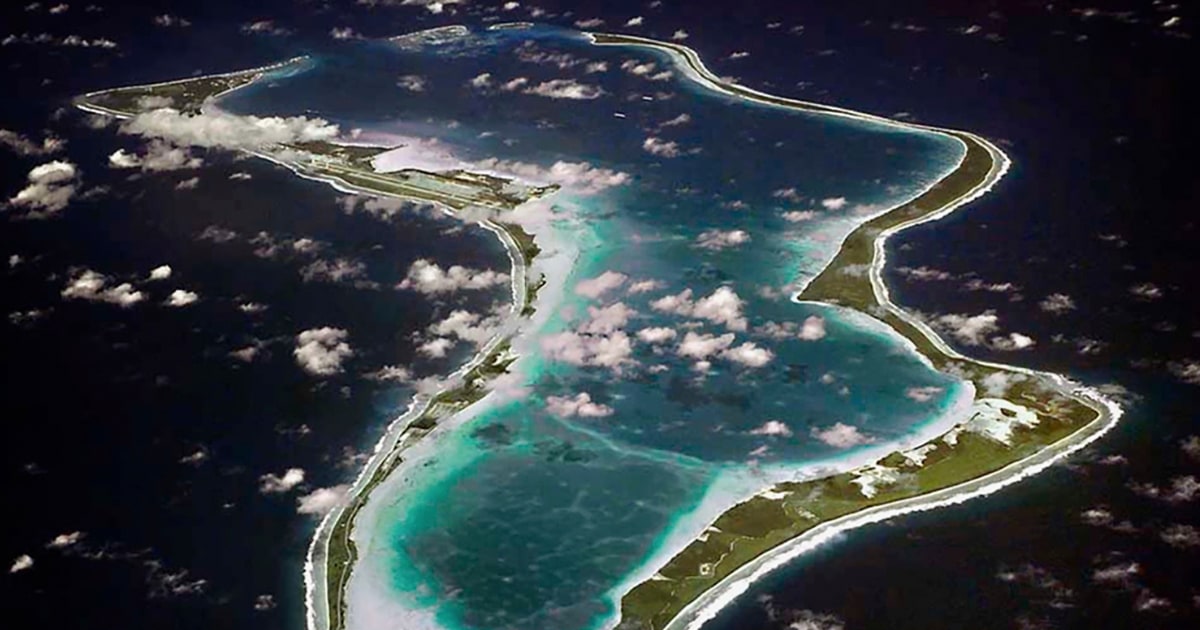
Iran launched a missile attack targeting the joint U.K.-U.S. Military base on Diego Garcia in the Indian Ocean on Saturday, a move Tehran claims demonstrates a previously undisclosed range in its missile capabilities. The unsuccessful strike prompted a condemnation from the U.K. Ministry of Defence, which called Iran’s actions “reckless” and a threat to British interests and allies.
Two intermediate-range ballistic missiles were fired towards the base, located in the remote Chagos Islands, over 2,000 miles from Iran, according to Iran’s semi-official Mehr news agency. Whereas neither missile struck the base, the attempted attack raises concerns about Iran’s evolving military reach. The distance to Diego Garcia is comparable to the distance from Iran to much of central Europe, suggesting a potential capability for longer-range strikes than previously acknowledged.
Iran’s Foreign Minister Abbas Araghchi stated earlier this month that the country had intentionally limited the range of its missiles to below 1,250 miles, stating, “we don’t want to be felt as a threat by anybody else in the world,” as reported by the BBC. However, the attack on Diego Garcia challenges this assertion.
U.S. Officials, cited by NBC News, indicate that one missile was intercepted by a U.S. Warship while the other failed mid-flight. Mehr news agency characterized the targeting of Diego Garcia as a “significant step” demonstrating a missile range exceeding previous estimates.
Tom Karako, who runs the missile defense project at the Center for Strategic and International Studies, noted that Iran has been developing “big, solid missiles” for years, and that the attack on Diego Garcia “would seem to be” the moment Iran has demonstrated its extended range capabilities. As reported by NBC News, speculation about Iran’s ability to strike beyond the 1,250-mile limit has existed previously, but this attack represents a clear demonstration of that potential.
The attack occurred shortly before the U.K. Announced it would permit the U.S. To utilize its bases, including Diego Garcia, for “defensive operations” aimed at protecting shipping in the Strait of Hormuz. This decision, made by government ministers in the office of Prime Minister Keir Starmer, follows weeks of conflict that has largely seen Britain remain on the periphery. Approximately 20% of the world’s oil supply transits the Strait of Hormuz, but shipping through the channel has largely ceased since the conflict began in late February.
President Donald Trump characterized the U.K.’s decision as a “very late response,” and has repeatedly criticized Starmer’s perceived lack of support, even calling him “no Winston Churchill.” He too condemned NATO allies as “cowards” for refusing to provide warships to secure the shipping channel, despite previously suggesting their assistance wouldn’t be necessary.
Iranian Foreign Minister Araghchi warned that Starmer was “putting British lives in danger” by allowing the use of U.K. Bases, stating, “Vast majority of the British People do not want any part in the Israel-U.S. War of choice on Iran.” He asserted Iran’s right to self-defense. Starmer’s government is navigating a delicate balance between maintaining diplomatic ties with the U.S., protecting U.K. Assets, and avoiding direct involvement in a conflict that is unpopular with the British public.
Diego Garcia, situated roughly 2,360 miles from Iran, serves as a key air base capable of supporting long-range U.S. Bombers. The Chagos Islands, where the base is located, are also subject to a separate dispute, as the U.K. Has agreed to cede sovereignty to Mauritius while retaining a 99-year lease for the military base. As reported by The Independent, Trump has publicly criticized Starmer over this agreement, despite Washington’s official backing.
Mauritius has long argued that it was illegally compelled to relinquish the archipelago in exchange for independence from Britain. The International Court of Justice sided with Mauritius in a 2019 advisory ruling, deeming the British occupation unlawful.
Leave a Reply