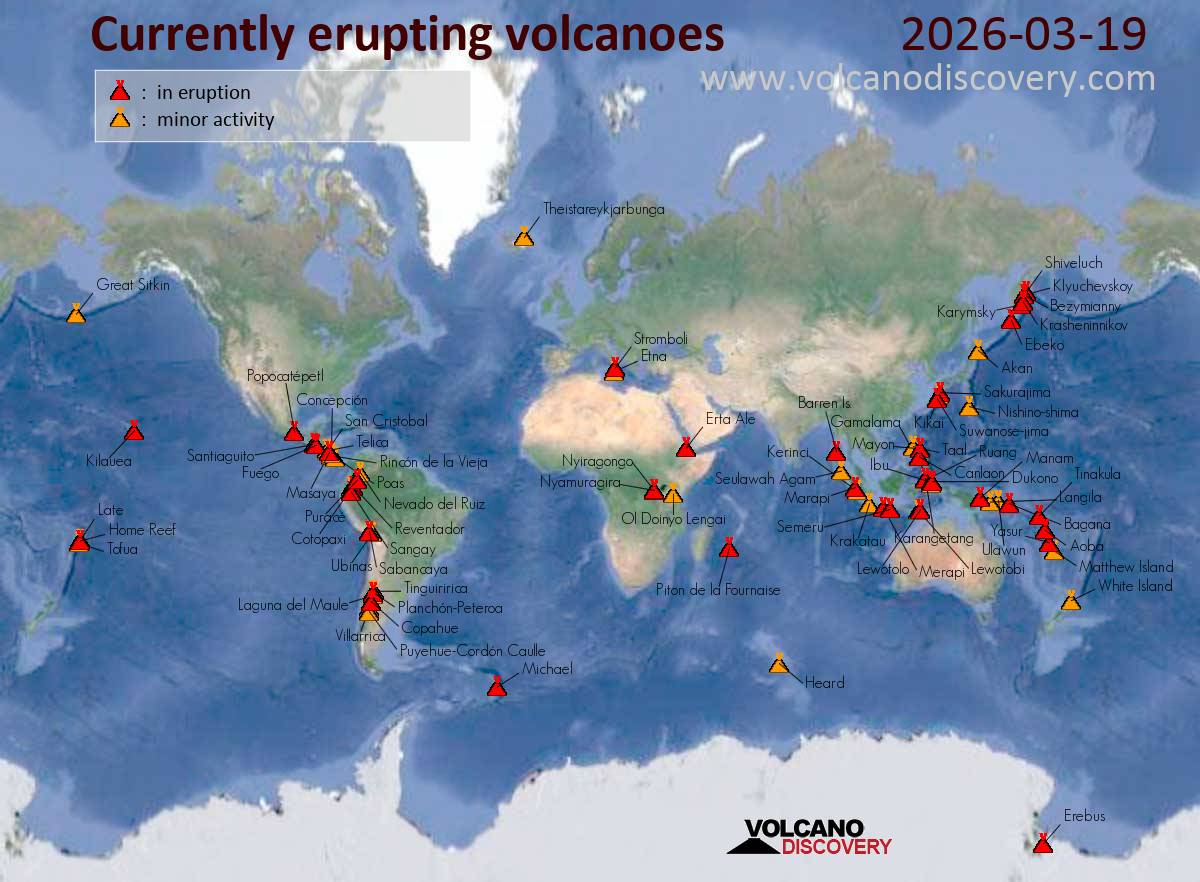
A volcanic ash plume from Russia’s Shiveluch volcano reached an altitude of 36,000 feet on Thursday, prompting alerts for aviation across the region, according to the Volcanic Ash Advisory Center (VAAC) Tokyo. The ongoing explosive activity continues to pose a potential hazard to aircraft.
The VAAC issued advisories detailing the plume’s eastward movement at 30 knots. Satellite imagery shows the ash cloud extending across a significant area, with observations dating back to March 19th. The advisory, released at 12:00 UTC on March 19th, identifies the volcano’s position as N5639 E16122 and its elevation as 3,283 meters above sea level.
Shiveluch, located on the Kamchatka Peninsula, is one of the most active volcanoes in Russia and part of the Pacific Ring of Fire. Recent reports indicate the ash is originating from the dome in the older part of the volcano, an area that became active again following a major eruption last April, according to volcanoes.de. A recent dome, initially named Karan-1 and later renamed “300 years of RAS,” has been growing on the edge of the older dome.
The current eruption is one of several ongoing volcanic events being monitored globally. The VAAC Tokyo also issued advisories for Lewotobi in Indonesia, with ash reaching 9,000 feet and Sangay in Ecuador, with ash reaching 21,000 feet. Elsewhere, the Philippine Institute of Volcanology and Seismology (PHIVOLCS) continues to monitor Mayon, Taal, and Canlaon, all exhibiting ongoing eruptive activity. Alert levels vary, with Mayon at a “3 – Increased Tendency Towards Hazardous Eruption” and Taal at a “1 – Low-Level Unrest.”
In Vanuatu, Aoba volcano is also experiencing ongoing explosive activity. In Mexico, Popocatépetl remains at a “Yellow Alert – Phase 2,” with reported gas and vapor plumes. Further south, Piton de la Fournaise on Réunion Island continues its effusive eruption, with a lava delta extending into the ocean, though authorities have warned of the health risks associated with the release of hydrochloric acid from the interaction of lava and seawater.
Monitoring continues at multiple Indonesian volcanoes, including Ibu, Merapi, Semeru, Dukono, and Lewotolo, all currently at alert levels ranging from “2 – Alert” to “3 – Standby.” In Peru, Sabancaya remains at an “Orange” alert level. The Center for Volcanology and Geological Hazard/Pusat Vulkanologi dan Mitigasi Bencana Geologi (CVGHM/PVMBG) is responsible for monitoring the Indonesian volcanoes, while the Instituto Geofísico-Escuela Politécnica Nacional (IG-EPN) monitors the Ecuadorian volcanoes.
The VAAC Tokyo’s next advisory for Shiveluch is scheduled for March 19th, 1500Z.
Leave a Reply