
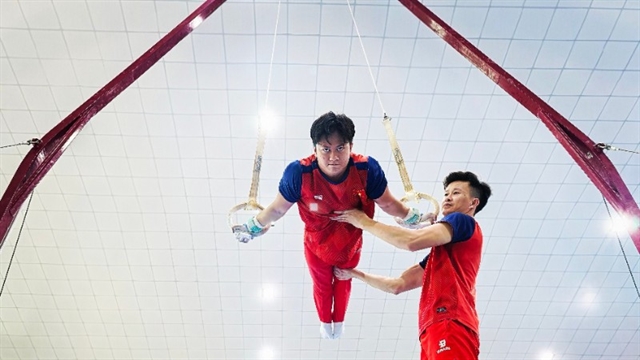
Vietnamese Gymnasts Eye Regional Dominance, Seek Long-Term Olympic Success
Hanoi, Vietnam – Vietnam’s gymnastics team is demonstrating increasing strength on the international stage, highlighted by recent successes at World Cup events, but officials are stressing the need for a thorough, long-term growth strategy to maintain regional leadership and target Olympic qualification.
The team has enjoyed a strong start to 2025, with Đặng Ngọc Xuân Thiện securing gold on the pommel horse and Nguyễn Văn khánh Phong earning silver on the rings at the FIG World Challenge Cup in Bulgaria in May, followed by performances at the Asian Championships in South Korea in June. These achievements underscore the team’s current high level of performance as they prepare for the World Championships in Indonesia this October, where they will face elite competition.
Currently, the team is undergoing rigorous review by the coaching board ahead of upcoming competitions in Bangkok. Coach Trương Minh Sang identifies rings, pommel horse, horizontal bar, and the all-round team as Vietnam’s strongest disciplines. However, he acknowledges strong challenges from Malaysia, Thailand, and notably the Philippines, fueled by the emergence of world champion Carlos Yulo.
“The Philippines has made remarkable progress,” Sang stated. “They have an advanced training system, a well-supported young athlete generation and are approaching continental levels. Yulo is a star with excellent technique and impressive competitive spirit, a big challenge for all opponents.”
Silver medalist Phong echoed the competitive sentiment, stating, “The SEA Games is still a challenge for us because all rivals are strong. But the stronger they are,the harder I will work.I will fix all mistakes and be as perfect as possible for the best result.”
Looking beyond immediate competition,Sang emphasizes the necessity of a long-term plan encompassing talent scouting,enhanced training for athletes and coaches,modernized training methodologies,facility upgrades,and crucially,improved attention to athlete nutrition,physical recovery,and injury prevention. he is currently working with promising gymnasts aged 15-16, believing that with adequate support – including opportunities for international training – they could contend for Olympic berths within four to six years.A key concern highlighted by both Sang and Phong is the current lack of adequate recovery resources for athletes. “High-intensity training without proper recovery increases the risk of injury,” Sang explained. “Many injuries do not come from accidents, but from prolonged overload.” Phong added that nutrition and rest are as vital as professional training for peak performance.
Hoàng Quốc Vinh of the Sports Authority of Vietnam agrees, stating, “We have to build a methodical plan that covers training, nutrition, injury recovery and equipment. We also need a clear direction for the next generation to be able to approach the 2026 ASIAD and the 2028 Olympics. This is not only a story about talent, but also depends on an international standard training habitat.”
