
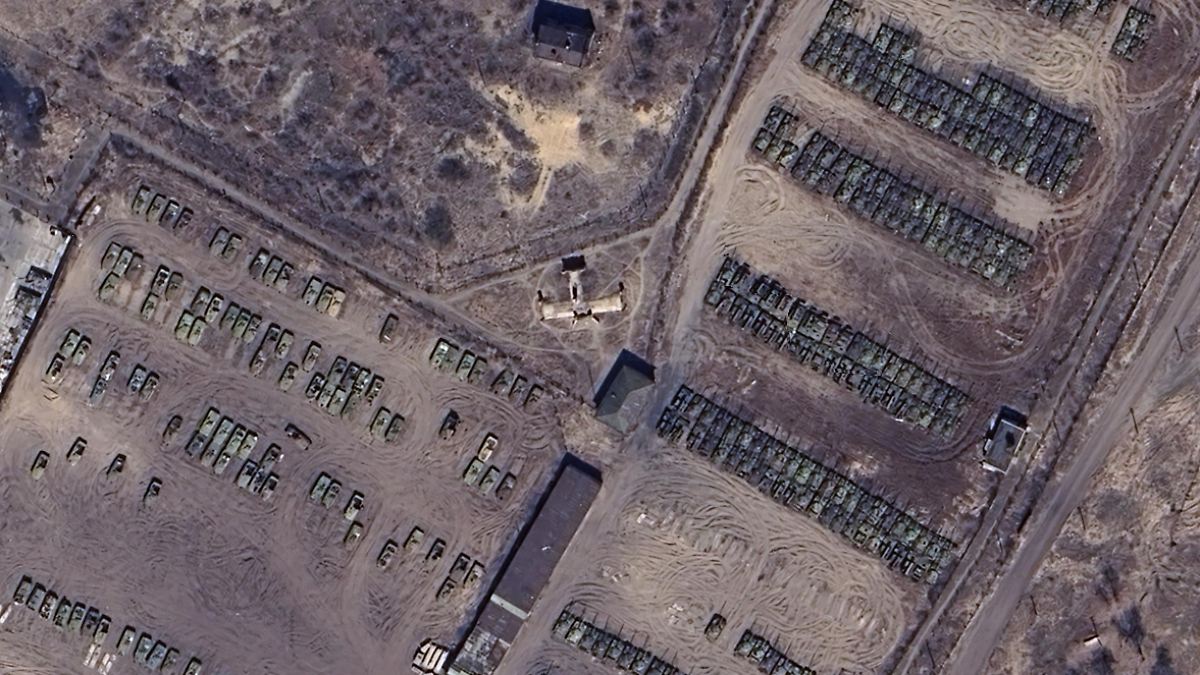
Russia‘s Tank Arsenals Diminish as Ukraine War Continues
Despite notable depletion of Soviet-era stockpiles and reports of poor vehicle condition, Russia’s tank war in Ukraine is not yet over. Analysis indicates a considerable decline in Russian main battle tank reserves over recent months, though continued production and repair efforts suggest a continued, if diminished, capability.
According to an open-source intelligence analyst known as “Jompy,” who utilizes satellite imagery to track Russian military equipment, the number of main battle tanks in Russian reserves has fallen from approximately 3,100 to around 2,500 between three and four months ago. His calculations, available here,also reveal that nearly 1,100 of those remaining tanks are in “very poor condition.” Since the start of the invasion of Ukraine, overall battle tank reserves have reportedly decreased by 65 percent.
Jompy’s analysis focuses on largely Soviet-era tanks being repaired or repurposed by Russian industry to offset losses sustained on the Ukrainian front. He estimates that the 624 remaining T-64 tanks,dating back to the 1960s,are likely candidates for scrapping or being cannibalized for spare parts. Additionally, 885 older T-62 tanks remain in the inventory, and are reportedly being repaired and redeployed.
A senior NATO official, speaking at the June summit in The Hague (as reported by European Pravda), indicated a total of approximately 2,000 older battle tanks remain on the Russian side.
Reduced Tank Deployments at the Front
While older tanks are being refurbished, Russia is also producing new T-90 tanks at an estimated rate of 200 to 300 per year. However, Ukrainian soldiers have reported a noticeable decrease in the frequency of Russian tank deployments in recent months. Correspondingly, daily reports from Kyiv regarding the destruction or severe damage of Russian battle tanks have significantly declined, sometimes reporting only one or even zero tanks lost per day.
A recent example of a larger-scale tank attack occurred near Ortes defendantyniwka, were a unit of the 93rd separate mechanized brigade reported hitting five main battle tanks and 13 armored personnel carriers wiht drones.
Continued Threat Despite Depletion
Despite the decline in numbers and the reliance on older equipment,analysts beleive Russia will continue to utilize tanks in its military operations. New production, ongoing repair efforts, and the reduced deployment in Ukraine all suggest a continued, albeit diminished, tank capability. The extent of vehicles held in hidden storage facilities, inaccessible to satellite analysis, remains unknown.
Western intelligence agencies assess that Russia is building up reserves, possibly for future use against a NATO state. The Kremlin’s forces retain a sufficient number of main battle tanks to represent a significant threat.
Beyond main battle tanks, Jompy’s analysis also includes other armored vehicles. He estimates 2,792 infantry fighting vehicles (IFVs) remain, with 1,525 in “very poor condition,” and 5,038 personnel carriers (APCs), of which 702 are also in poor condition.
