
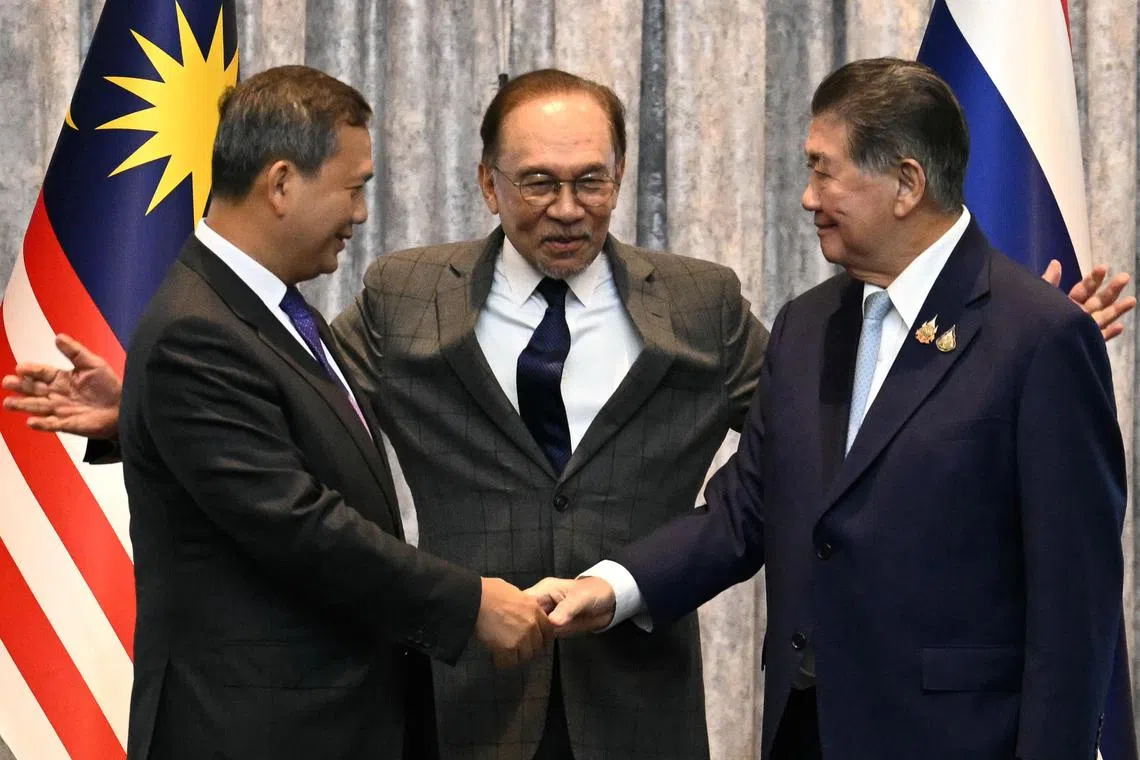
ASEAN Secures Cambodia-Thailand Ceasefire Amid Border Clashes
Malaysia’s Diplomatic Push Averts Wider Conflict
A tense border dispute between Cambodia and Thailand, which claimed over 30 lives, has reached a critical turning point with a brokered ceasefire agreement. The accord, secured on July 28, marks a significant diplomatic success for ASEAN, particularly for chair Malaysia, offering a glimmer of hope for regional stability.
Fragile Peace Achieved Through Joint Diplomacy
The breakthrough was announced following an emergency meeting in Kuala Lumpur, hosted by Malaysian Prime Minister Anwar Ibrahim. This diplomatic victory for the Association of Southeast Asian Nations comes at a time when its efficacy has been increasingly scrutinized amid stalled progress on other regional issues. However, analysts remain cautious, questioning the long-term sustainability of this peace.
The conflict had been escalating since July 24, with sporadic but deadly clashes erupting along the disputed border. The heightened tensions prompted intensified diplomatic efforts, spearheaded by Malaysia and bolstered by strong backing from both the United States and China.
External Pressure Fuels Diplomatic Advance
US President Donald Trump played a pivotal role, issuing a stern warning on July 27 that Washington would suspend trade deals with either nation if the violence continued. Both Cambodia and Thailand faced the imminent threat of a 36 percent US tariff scheduled to take effect on August 1. China also voiced its deep concern over the fighting on July 24, pledging to facilitate dialogue and de-escalation.
Representatives from both the US and China were present at the July 28 meeting, which Malaysia confirmed was a collaborative effort involving Washington’s coordination and Beijing’s active participation.
“Malaysia’s leadership was crucial as the organisation’s chair to mediate between Thailand and Cambodia, while also leveraging the importance of China and the US, both dialogue partners of Asean, to further reaffirm that this ceasefire can be brought into fruition.”
—Dr Mustafa Izzuddin, Senior International Affairs Analyst
ASEAN’s Reliance on External Forces Highlighted
While hailed as an ASEAN-driven diplomatic success, the agreement also underscores the grouping’s dependence on external pressure and proactive leadership rather than robust institutional frameworks. Analysts point out that ASEAN lacks inherent enforcement mechanisms, a weakness amplified by past instances where proposals for monitoring mechanisms, like Indonesia’s suggestion during the 2011 Preah Vihear clashes, were rejected due to sovereignty concerns.
Under the terms of the ceasefire, both Cambodia and Thailand have committed to an immediate and unconditional cessation of hostilities. The proposed roadmap for peace includes informal discussions between military commanders and a general border committee session slated for August 4.
Path to Lasting Peace Faces Hurdles
Malaysia, in its capacity as ASEAN chair, has offered to spearhead an observer team, seeking participation from fellow member states to provide regional verification and support. However, experts caution that the implementation phase could prove challenging, given ASEAN’s limited enforcement capabilities.
“A ceasefire is an immediate and very short-term solution. What is more important is for the ceasefire to hold in the long run while Cambodia and Thailand negotiate their border disputes,” stated Dr Abdul Rahman Yaacob, a research fellow at the Lowy Institute. “One possible mechanism is the deployment of Malaysian or Asean observers along the Thai-Cambodia border. This is critical, given the strategic mistrust between (the two sides).”
The underlying causes of the current conflict remain somewhat obscure, though some speculate that both sides perceived domestic political advantages in allowing it to escalate. While historical grievances regarding border demarcation persist, recent confrontations appear to have been partly influenced by internal political strategies.
“The biggest risks lie in lingering distrust and potential miscommunication along contested border areas, and the absence of any formal verification mechanism,” noted Ms Joanne Lin, a senior fellow at the ISEAS – Yusof Ishak Institute. “ASEAN does not have institutional tools like independent observers or peace monitors to oversee implementation on the ground.”
These limitations raise broader questions about ASEAN’s approach to managing internal conflicts. Some experts warn that without sustained follow-up actions, the bloc could revert to passivity once the immediate crisis subsides.
“The outcome was driven largely by Malaysia’s personal diplomacy and strong external pressure, rather than any institutional mechanism within ASEAN,” Ms Lin added regarding the ceasefire. “Without efforts to institutionalise these crisis response lessons, the group risks falling back into passivity.”
Dr Rahman concurred, asserting that ASEAN possesses the capacity to maintain peace, provided there is sufficient political will. He highlighted that an ASEAN-led ceasefire is generally more palatable than one imposed by external powers, emphasizing that the bloc offers a familiar platform for its conflicting members to engage in dialogue and resolve the crisis.
Malaysia’s Diplomatic Standing Boosted
The diplomatic achievement is also viewed as a significant boost for Malaysia’s international standing. Mr Adib Zalkapli, managing director of geopolitical consultancy Viewfinder Global Affairs, commented that it demonstrates Malaysia’s capability to play a crucial role in regional peacebuilding.
Domestically, the successful negotiation of the peace deal could offer a temporary political advantage to Datuk Seri Anwar. According to Dr Oh Ei Sun, a senior fellow at the Singapore Institute of International Affairs, “Anwar of course scores some brownie points in brokering this peace that could potentially offset some of his domestic political troubles.”
Nevertheless, observers agree that the coming weeks will be crucial in determining the longevity of the ceasefire and ASEAN’s ability to foster sustained peace.
“While holding the talks can be seen as a success, there will not be easy solutions to this longstanding issue,” said Dr Bridget Welsh, an honorary research associate at the University of Nottingham Asia Research Institute Malaysia. As of early 2023, the global number of displaced persons reached an estimated 110 million, highlighting the widespread impact of ongoing conflicts (UNHCR). This underscores the urgency for durable peace solutions.
For an organization frequently criticized for its inaction on crises such as those in Myanmar and the South China Sea, this truce presents an opportunity to affirm its relevance and maintain momentum.
“The real test now lies in verifying the ceasefire and whether ASEAN can follow through with implementing its own peace mechanisms,” stated Ms Lin. The effectiveness of these nascent mechanisms will be critical for the bloc’s credibility.
Dr Mustafa concluded that while the ceasefire represents a significant win, it remains fragile. Ground realities suggest a potential for rapid breakdown. “So it is incumbent on the political leaderships of both Cambodia and Thailand to maintain the ceasefire by not succumbing to domestic political pressures, and on Malaysia as the honest broker to remind both countries about their bilateral obligations in keeping the peace,” he advised.
