
Satellite Data Provides Frist Detailed View of Tsunami‘s Broad structure
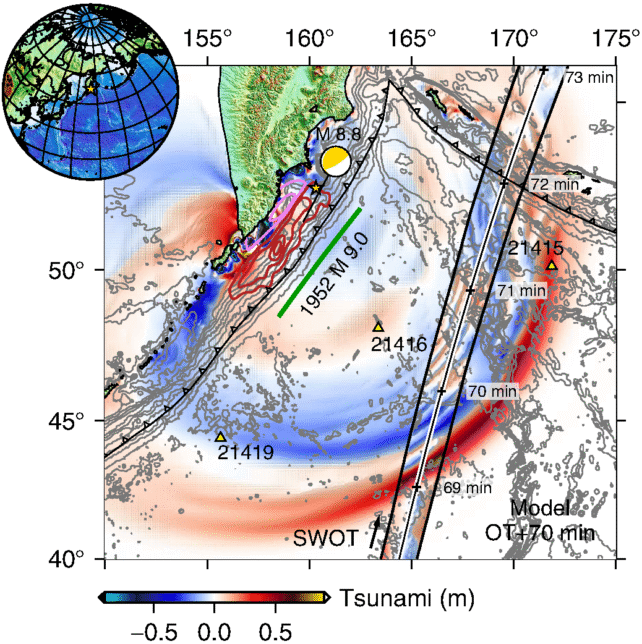
REYKJAVIK, ICELAND - In a breakthrough for disaster monitoring, scientists have captured the most detailed view yet of a tsunami propagating across the ocean, revealing a surprisingly wide structure previously unseen with existing technologies. Data from the Surface Water and Ocean Topography (SWOT) satellite allowed researchers to observe the full breadth of the wave generated by a recent, moderate-magnitude earthquake, offering new insights into tsunami dynamics and perhaps improving future warning systems.
The study, published in The Seismic record, demonstrates SWOT’s unique ability to map a 120-kilometer (75-mile) wide swath of the ocean surface with high resolution. This contrasts sharply with customary buoy-based systems like Deep-ocean Assessment and Reporting of Tsunamis (DARTs), which provide data from specific points, and earlier satellite observations limited to narrow lines.The findings underscore the potential of SWOT to revolutionize tsunami monitoring,providing a more comprehensive understanding of these perilous events and extending crucial warning times for coastal populations.
The tsunami, triggered by an earthquake in the Pacific Ocean, exhibited a leading wave exceeding 45 centimeters (1.5 feet) in height, as captured by SWOT. The satellite data pinpointed the earthquake’s hypocenter and revealed the wave’s expansive nature. “I think of SWOT data as a new pair of glasses,” explains Angel Ruiz-Angulo,a physical oceanographer at the University of Iceland and lead author of the study. “Before,with DARTs we could only see the tsunami at specific points in the vastness of the ocean. There have been other satellites before, but they only see a thin line across a tsunami in the best-case scenario.”
Researchers believe that with opportune timing, SWOT, in conjunction with other satellites, could be instrumental in real-time detection and tracking of future tsunamis. This capability is critical for maximizing warning lead times and mitigating the impact of these devastating natural disasters on vulnerable coastal communities. The research team’s findings represent a notable step forward in utilizing space-based technology for enhanced tsunami preparedness and response.
