
Ancient Jawbone Rewrites Mammal Evolution
Student’s Dorset Discovery Unveils New Prehistoric Species
A remarkable fossil unearthed during a student field trip along the Dorset coast is offering scientists unprecedented insights into early mammal evolution. A minuscule 16.5-millimeter lower jaw, discovered near Swanage, belongs to a previously unknown species of extinct multituberculate mammal.
A Remarkable Find
The fossil was located at Durlston Bay, a site renowned for its rich geological history. This marks the first discovery of a multituberculate jaw from this location since the 1800s. Though superficially resembling a rabbit’s jaw, its unique tooth structure—featuring a prominent incisor, a gap, and four blade-like premolars—distinguishes it.
“I instantly had my suspicions of what the jaw was when I found it at the beach, but couldn’t have imagined where the discovery would take me,” stated undergraduate paleontology student, Ben Weston. He added, “I’m extremely grateful to the team and to the university for helping me take my first steps into academic paleontology.”
Technology Illuminates Ancient Life
Researchers at the University of Portsmouth utilized high-resolution CT scanning to meticulously examine the fossil, which had rock adhering to crucial areas. This non-invasive technique allowed scientists to digitally separate the jaw and its teeth from the surrounding matrix.
Jake Keane, a former student now working in Abu Dhabi, processed the scans, isolating the teeth with exceptional detail. The data was then transformed into enlarged 3D-printed models by John Fearnly, the university’s lead technician in technology, facilitating in-depth study.
Introducing *Novaculadon mirabilis*
The newly identified species has been christened *Novaculadon mirabilis*. The genus name “Novacula” references the sharp, razor-like appearance of its back teeth, while “mirabilis” acknowledges the jaw’s near-perfect state of preservation.
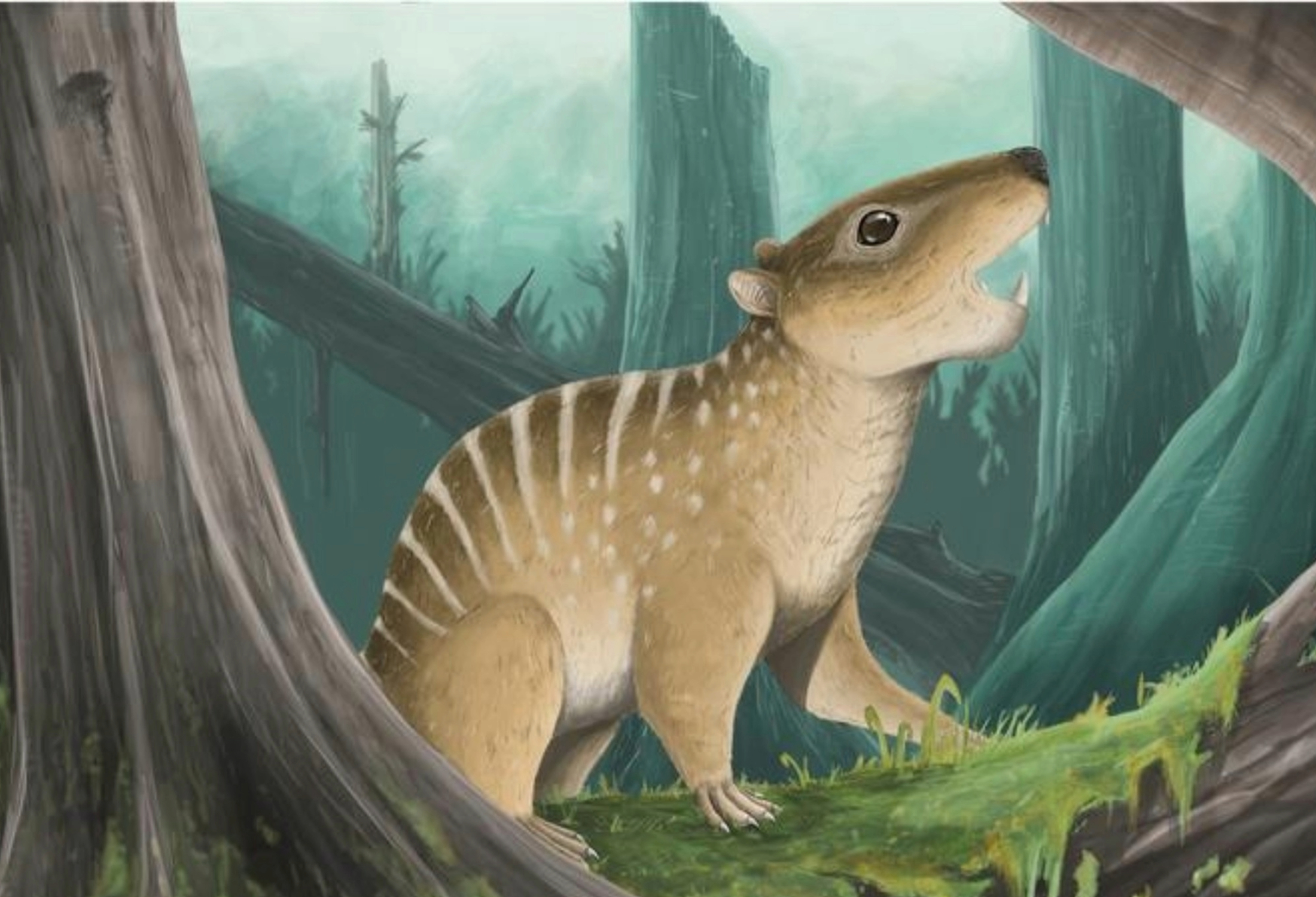
An artistic rendition by student Hamzah Imran imagines the creature as a small, possibly spotted and striped, furry mammal. Based on its dental features, *Novaculadon mirabilis* likely consumed insects and other small invertebrates. This dietary specialization, indicated by its specialized teeth, helped it thrive alongside dinosaurs. For context, the diversity of mammal species during the Mesozoic era has been significantly expanded by such finds, contributing to our understanding of how they survived mass extinctions.
A Hotspot for Paleontological Discoveries
Durlston Bay has proven to be a fertile ground for significant paleontological discoveries attributed to students. In 2017, undergraduate Grant Smith uncovered fossils of two new mammal species, believed to be among humanity’s earliest ancestors.
“This is a remarkable find that reminds me of when Grant found those extraordinary eutherian mammal teeth,” commented Dr. Steve Sweetman, a researcher at the University of Portsmouth. “When I first saw Grant’s specimens, my jaw dropped – and I had exactly the same reaction to Ben’s multituberculate jaw. It’s incredible that Durlston Bay keeps delivering such significant mammal discoveries by our undergraduate students.”
Unlocking Evolutionary Secrets
The discovery underscores the power of collaborative research, with academics, technicians, and students contributing to the comprehensive description of *Novaculadon mirabilis*. Professor David Martill highlighted this, stating, “Looking back now that the discovery has been published, I am amazed at how many people it took to describe this little mammal.” He further emphasized, “I especially appreciated that all team members were University staff or present and former students – a true team effort including academics, technicians, alumni, and students with diverse talents across three departments.”
Multituberculates, a group comprising over 200 species, represented the most diverse mammal lineage during the Mesozoic era, occupying various ecological niches from burrowing to arboreal lifestyles. While they survived the extinction event that ended the age of dinosaurs, they ultimately disappeared around 33 million years ago. This latest find adds a crucial piece to the puzzle of their evolutionary journey and survival strategies.
The comprehensive study detailing this significant discovery has been published in the journal *Proceedings of the Geologists Association*.
