
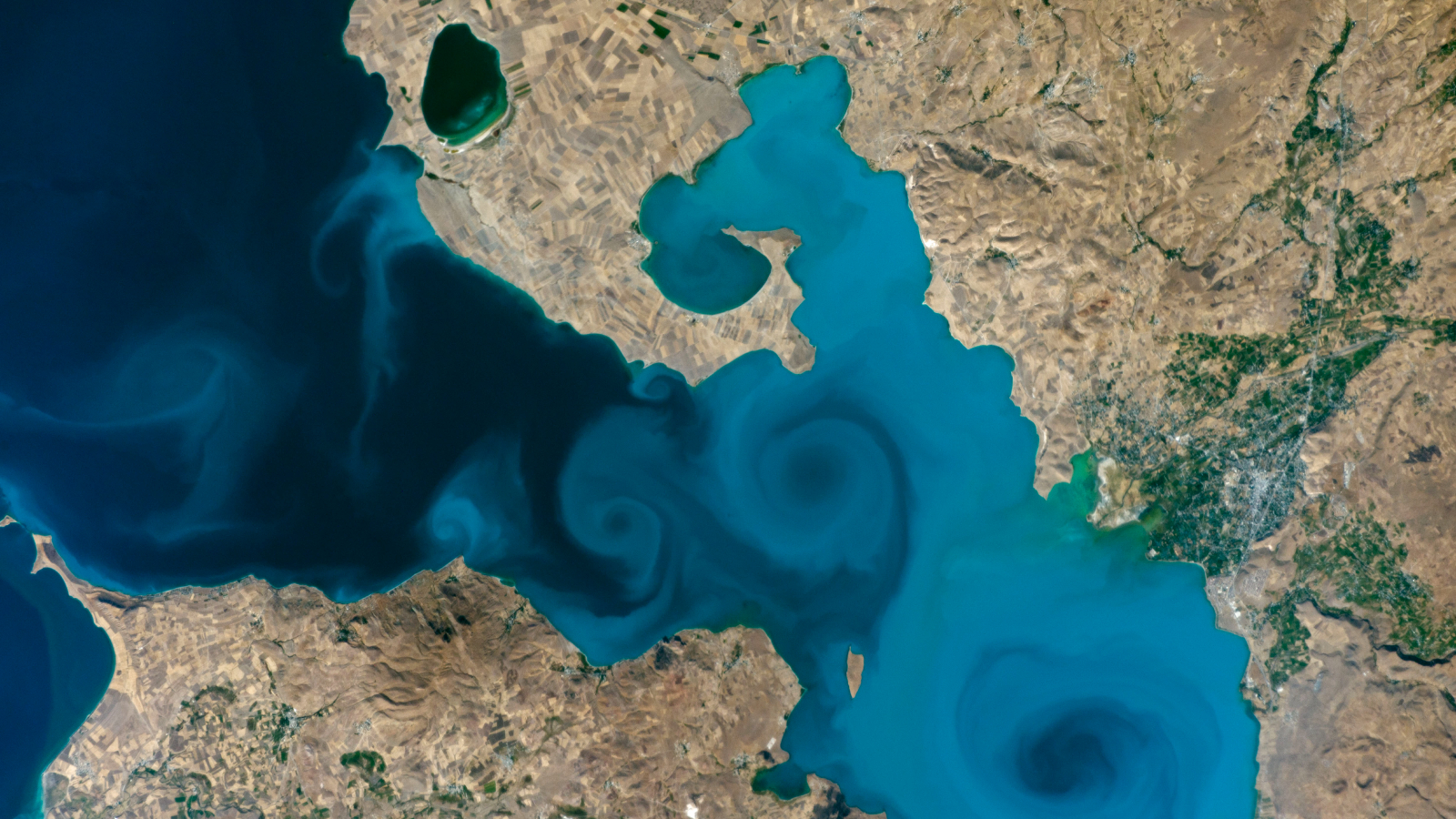
Mysterious Milky Swirls Appear in Turkey’s Lake Van, Baffling Scientists
LAKE VAN, TURKEY – Striking satellite images have revealed large, milky swirls appearing in the waters of Lake Van, Turkey’s largest lake, prompting examination into their origin. While initially suspected to be algal blooms, experts now believe the phenomenon is highly likely caused by unique physical processes within the lake’s highly alkaline waters, a characteristic that sets it apart from most other large bodies of water on Earth.
Lake Van, located in eastern turkey, is the world’s largest alkaline, or “soda,” lake, boasting a pH level of around 10. This high alkalinity stems from the lake’s “endorheic” nature – meaning it has no outlet – leading to a build-up of carbonate salts as water evaporates. The concentration of these salts is so significant that the lake rarely freezes, even when temperatures dip below 32 degrees Fahrenheit (0 degrees Celsius) in winter.
The swirls, captured by satellite imagery analyzed by NASA’s Earth Observatory, are not related to the seasonal peaks in microbialite production, despite Lake Van harboring one of the highest concentrations of this organo-sedimentary structure globally. Microbialites are formed by microbes trapping, binding, and precipitating minerals, and their growth is most active in spring and fall.
“These aren’t algal blooms,” explained researchers at the Earth Observatory. The exact mechanism creating the swirls remains under investigation,but it’s believed to be linked to the lake’s unique chemical composition and water dynamics.
A Lake Shaped by Millennia of Climate Change
Lake Van’s unusual characteristics aren’t new. The lake has a complex history, with water levels fluctuating dramatically over the past 600,000 years due to shifts in Earth’s climate, impacting both water input and evaporation rates. A 2014 study published on ResearchGate estimated that the lake’s depth has varied by as much as 2,000 feet (600 meters) over this period, influenced by climatic, volcanic, and tectonic activity. The study, led by researchers examining sediment cores, provided a detailed reconstruction of the lake’s past water levels.
The lake’s geological setting within the eastern Anatolian Rift Valley also contributes to its unique characteristics. the rift valley is a tectonically active region, and ongoing geological processes influence the lake’s shape and water chemistry.
While the large swirls are not attributable to algal blooms, smaller concentrations of phytoplankton are visible along the coastline of Erciş and within a smaller lake near the image’s upper portion, demonstrating the presence of life within this extreme surroundings.
Lake Van continues to be a subject of scientific interest, offering a valuable window into the interplay between geology, climate, and microbial life in an unusual and fascinating ecosystem. Further research is needed to fully understand the processes driving the formation of these mysterious swirls and to predict how the lake might respond to future climate changes.
