
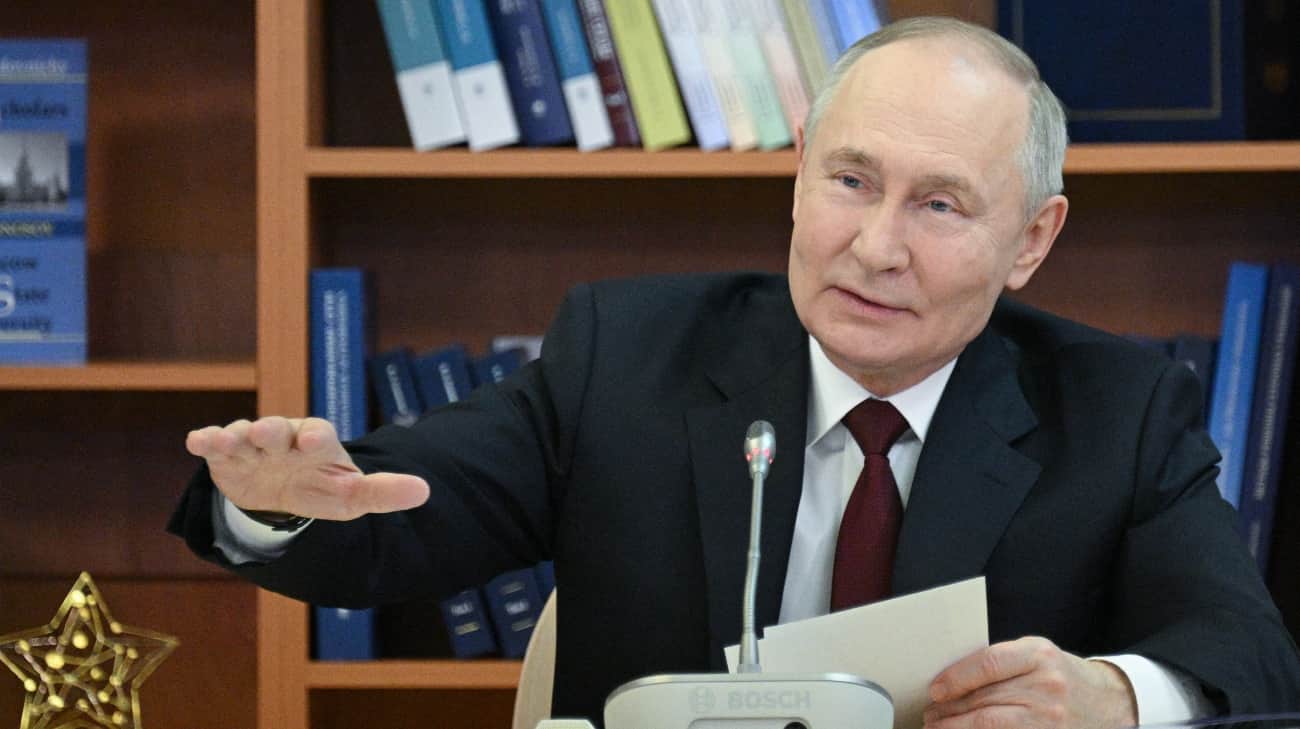
Putin’s Statements on Ukraine: A strategy to Justify Future Agreement Violations?
Analysts from the Institute for the Study of War (ISW) suggest that Russian President Vladimir Putin’s recent statements on the illegitimacy of the Ukrainian government and potential peace agreements may serve as a tool to justify violating any future agreements with Ukraine.
Putin’s legal Manipulations
According to ISW, the Kremlin is actively creating a legal basis to ignore future agreements by manipulating false interpretations of Ukrainian legislation.Putin has repeatedly claimed that Ukrainian President Volodymyr Zelensky lost legitimacy due to the absence of elections in 2024 under martial law. He asserts that the Verkhovna rada, Ukraine’s parliament, is the only legitimate branch of government. However, Putin has also called for unconstitutional actions by the Rada, which could later be used to declare it “illegitimate.”
“Putin indicated that it woudl not consider peace agreements as mandatory for implementation, while the decree of President Zelensky from 2022 is in force on the ban on negotiations with him,” ISW reported. “Though, even if the Ukrainian side agrees to cancel this decree, Putin will probably find new grounds for violating agreements.”
A History of Broken Promises
This tactic is not new. The Kremlin has previously used similar strategies to justify violating the Minsk agreements of 2014 and 2015. ISW warns that even if ukraine were to agree to negotiations, Putin would likely violate any resulting agreements, citing false justifications such as the invalidity of the agreements or the illegitimacy of the Ukrainian government.
“Even if Zelensky or other representatives of the Ukrainian government agree to cancel the decree on the prohibition of negotiations with Putin,Putin will most likely violate any peace or other agreement that he will reach with Ukraine,under the false justification that such agreements are ‘invalid’ while he assumes that he can achieve his maximalist military goals with the help of military operations,” ISW stated.Key ISW Conclusions
The ISW report highlights several critical points:
- Western military aid remains vital for Ukraine’s defense against Russian aggression.
- Putin’s long-standing theory of victory relies on the assumption that the West will abandon Ukraine.
- Putin continues to push for bilateral negotiations with the U.S., excluding Ukraine, to advance Kremlin-friendly outcomes.
Recent developments
On the night of January 28-29, ukrainian forces launched drone strikes on a Russian oil refinery in the Kstovo region and a Russian arsenal in the Tver region. Meanwhile, Ukrainian troops advanced in the Kursk region and near Toretsk, while Russian forces made gains near Robotino and in the Dnieper direction.
Volunteer Recruitment Declines
The report also notes a sharp decline in volunteer recruitment in Moscow, as Russian citizens increasingly resist fighting in Ukraine.
Summary Table: Key Points from ISW Report
| Key Insight | Details |
|———————————————————————————|———————————————————————————————–|
| Putin’s stance on peace agreements | He will not consider them mandatory and may violate them under false justifications. |
| Legitimacy of Ukrainian government | Putin claims Zelensky is illegitimate and calls for unconstitutional actions by the Rada. |
| Western military aid | Essential for Ukraine’s defense and to force Putin to consider concessions. |
| Recent military developments | Ukrainian advances in Kursk and toretsk; Russian gains near Robotino and the Dnieper. |
| decline in Russian volunteer recruitment | Fewer Russian citizens are willing to fight in Ukraine. |
Putin’s statements and actions underscore a broader strategy to undermine Ukraine’s sovereignty and justify future violations of agreements. As the conflict continues, the role of Western support and Ukraine’s resilience remain critical in shaping the outcome.
