
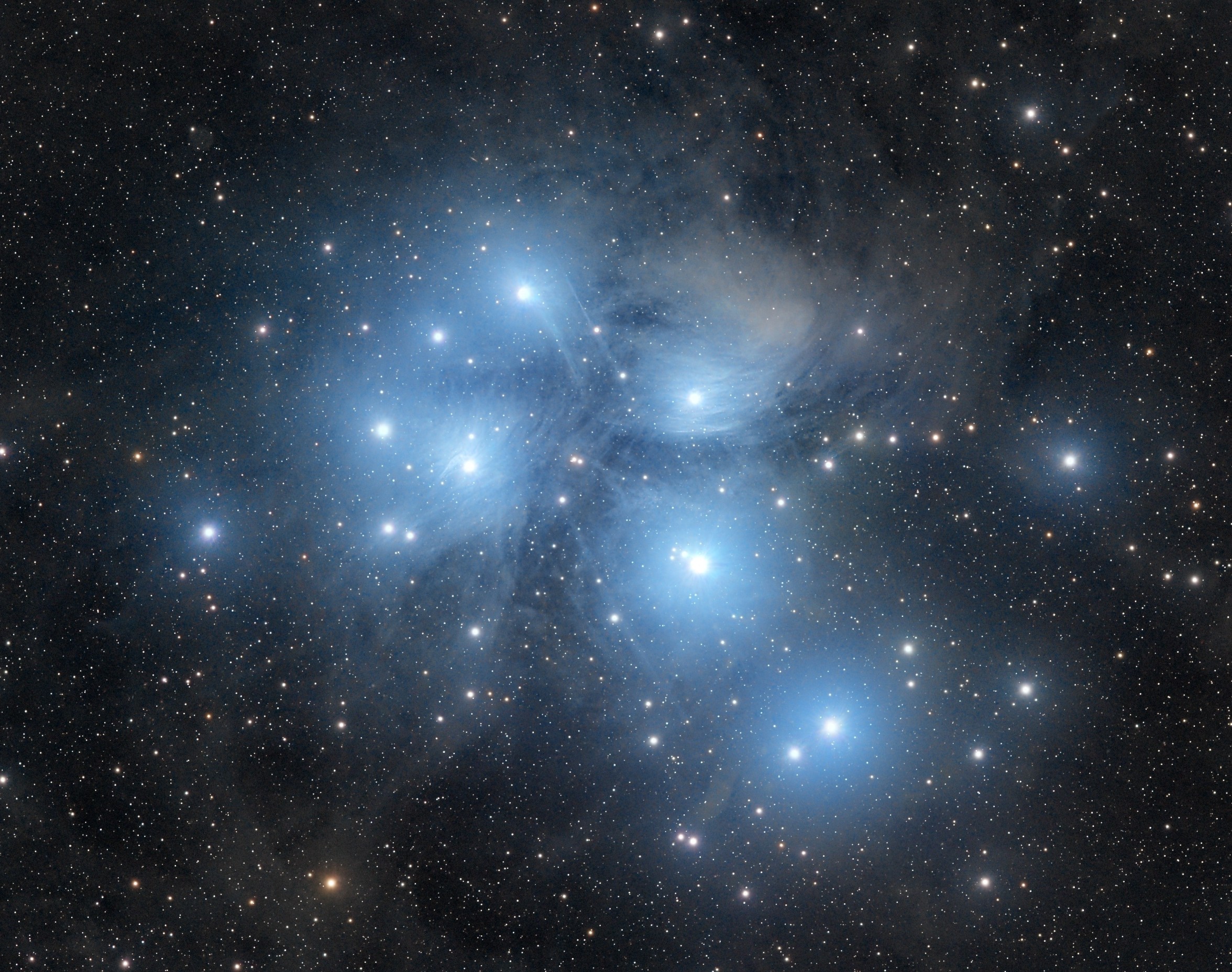
Hidden Stellar Family Discovered Behind the pleiades Star Cluster
New research reveals the Pleiades star cluster is highly likely the luminous core of a much larger, 100-million-year-old stellar complex, challenging previous understandings of its origin adn evolution.
Astronomers have uncovered evidence suggesting the well-known Pleiades star cluster isn’t an isolated group, but rather the radiant center of a sprawling, dispersed stellar family. The findings, published in The Astrophysical Journal, stem from a novel combination of data from the Gaia, TESS, and SDSS missions.
The team, led by Andrew Boyle, utilized Gaia’s precise measurements of stellar motion, TESS’s observations of stellar rotation periods, and spectroscopic data from SDSS detailing stellar chemistry. Individually, these datasets offered incomplete pictures. Gaia provides a detailed sky map but lacks age details.TESS dates stars through rotation but doesn’t reveal orbital paths. Spectra reveal chemical composition but not movement. However, when integrated, these datasets revealed a previously hidden connection between stars.
“On their own, the data from each mission were insufficient to reveal the full extent of the structure,” explained Boyle.”But when we integrated them – linking stellar motions from Gaia, rotations from TESS, and chemistry from SDSS – a coherent picture emerged. It was like assembling a jigsaw puzzle,where each dataset provided a different piece of the larger puzzle.”
Kinship analysis, coupled with rotation-based ages and Gaia kinematics, indicates these stars were once much closer together before being dispersed by galactic tides and random motions. This reframes the Pleiades, traditionally a benchmark for astronomical measurements, as a key component of a larger coeval complex, altering how astronomers interpret its birth surroundings and subsequent development.
The research provides a template for identifying other dispersed stellar families throughout the milky Way. Because stellar rotation predictably slows with age, the team’s methodology can potentially age-date and group vast numbers of stars by shared origin. With ongoing data collection from Gaia, TESS, and SDSS, scientists anticipate uncovering many more of these hidden stellar complexes.
“the Pleiades has played a central role in human observations of the stars since antiquity,” said Dr. Bouma. “This work marks a big step toward understanding how the Pleiades has changed as it was born one hundred million years ago.”
The methodology holds promise for age-dating hundreds of thousands of stars in our galactic neighborhood and reconnecting stellar families previously considered lost to time.
