
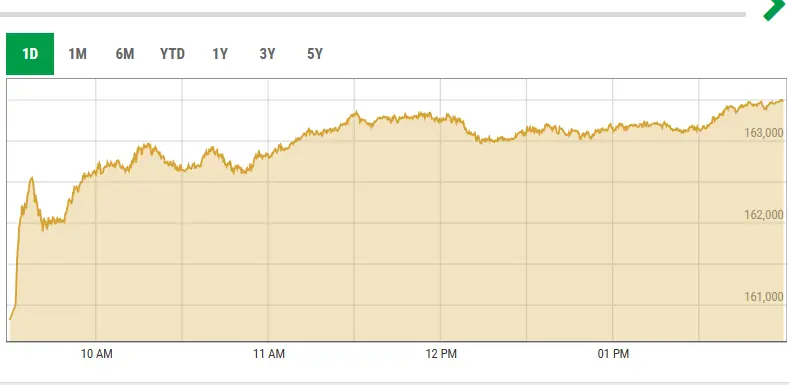
Karachi, Pakistan – Pakistan’s benchmark KSE-100 index experienced a meaningful rebound today, surging 5,054.50 points, or 3.19%, to close at 163,497.92 by 2pm, following a sharp decline yesterday.The recovery comes amid easing tensions with Afghanistan and a calming of domestic unrest.
The surge reverses losses from the previous day, when the market closed lower by 4,654 points, or 2.85%,at 158,443 points,pressured by border clashes with Afghanistan and violent protests within pakistan. Analysts attribute today’s gains to a reduction in these immediate concerns, alongside investor focus shifting to upcoming economic data.
According to Yousuf M. Farooq, director of research at Chase Securities, the market rebounded as “tensions with Afghanistan and domestic unrest following the breakup of Tehreek-i-labbaik Pakistan (TLP) protests had eased overnight.” He added that participants are now focused on next week’s current account print and progress toward a staff-level agreement with the International Monetary Fund.
September saw the opening of 12,334 new investor accounts, prompting Farooq to advise retail investors to adopt a “long-term approach, build positions gradually, and consider exchange-traded funds or mutual funds if inexperienced.” However, he cautioned that potential economic headwinds could limit future returns, stating, “While valuations are reasonable, potential slippage on the current account and fiscal side could pose near-term headwinds, and a repeat of the last two years’ returns over the next two years appears unlikely.”
Samiullah Tariq,head of research and advancement at Pak Kuwait Investment Company ltd,confirmed the market had “rebounded after correction” and that the “easing of geopolitical conditions” had provided support.
yesterday’s downturn was triggered by intense border fighting between Pakistan and Afghanistan, resulting in the martyrdom of 23 Pakistani troops and the deaths of 200 Taliban and affiliated terrorists, according to the Inter-Services Public Relations (ISPR). Simultaneously, a crackdown on Tehreek-i-Labbaik Pakistan (TLP) protesters and political uncertainty in Khyber Pakhtunkhwa added to the market’s woes.
