
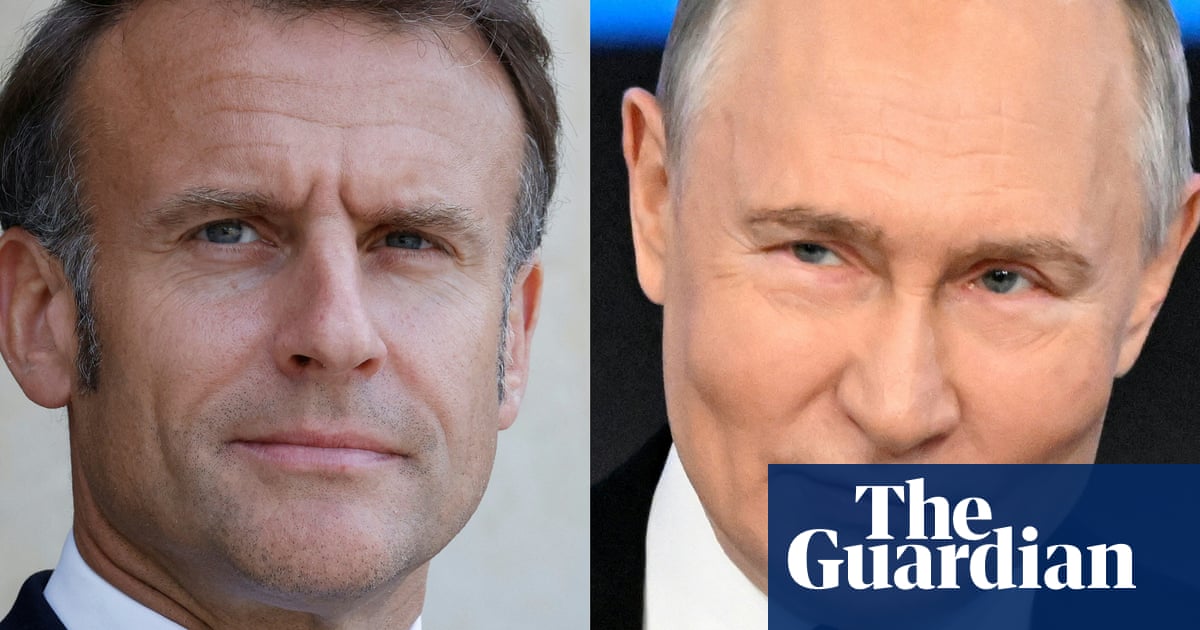
Macron and Putin Talk as Iran Ends Nuclear Cooperation
French president seeks to de-escalate crisis as Tehran restricts UN access.
In a significant diplomatic move, Emmanuel Macron spoke with Vladimir Putin for the first time in three years on Tuesday in an attempt to address the escalating Iran crisis, as Tehran pulls back from commitments to nuclear monitoring.
French Initiative
Macron had previously avoided direct communication with Putin following the 2022 invasion of Ukraine. Paris is increasingly concerned that the absence of dialogue with Moscow is hampering diplomatic efforts and leaving opportunities open to Donald Trump.
Following the two-hour conversation, a French spokesperson indicated that Macron was more optimistic about the possibility of Russia influencing Iran to resume its cooperation with the International Atomic Energy Agency (IAEA).
France also signaled a willingness to discuss Iran’s insistence on its right to enrich uranium domestically.
One justification offered by Iran for its reduced cooperation with the IAEA centers on the agency’s perceived failure to condemn Israeli strikes against Iranian nuclear sites as violations of the Treaty on the Non-Proliferation of Nuclear Weapons.
International Reactions
Germany’s foreign ministry described Iran’s decision to halt cooperation with the IAEA as sending a “disastrous signal,”
adding, “For a diplomatic solution it is essential for Iran to work with the IAEA.”
Berlin stated they were informed in advance of the Macron-Putin call.
Jean-Noël Barrot, the French foreign minister, has also urged Iran to cooperate with the IAEA. He noted that while Israel’s strikes “are not in accordance with international law,”
and have “certainly set back Iran’s nuclear programme,”
only negotiation can ensure lasting safety.
He added, “We support the resumption of US negotiations with Iran, but it is essential that our security interests be taken into account. European territory is potentially within range of missiles designed in Iran.”
Asked about Iran’s right to enrich uranium domestically, Barrot stated: “What is essential is that Iran cannot acquire a nuclear weapon under any circumstances.”
French officials did not dismiss the possibility of Iranian domestic enrichment, as outlined in the 2015 nuclear agreement.
Kremlin Statement
According to the Kremlin’s account of the call, “It was noted that respecting Tehran’s legitimate right to develop peaceful nuclear technology and continue to fulfil its obligations under the treaty on the non-proliferation of nuclear weapons, which includes cooperating with the IAEA, was crucial.”
The Kremlin readout continued: “The two leaders spoke in favour of settling the crisis around Iran’s nuclear programme and any other differences arising in the Middle East exclusively via political and diplomatic means. They agreed to maintain contact in order to coordinate their stances if necessary.”
Tehran’s Position
Iran has been steadily reducing its engagement with the IAEA, complicating independent assessments of the damage inflicted on its nuclear facilities by strikes. On June 25, the Iranian parliament passed a bill suspending cooperation with the UN agency.
The legislation was subsequently approved by the Guardian Council and ratified by Iranian president, Masoud Pezeshkian. State media confirmed the law is now in effect.
Currently, a small number of IAEA inspectors are believed to remain in Iran. Meanwhile, the World Nuclear Association reports that Iran has one operating nuclear power plant at Bushehr, along with research reactors and uranium processing facilities (WNA).
Broader Diplomatic Efforts
Regarding the postponed UN special conference on the two-state solution, Barrot said France is discussing possible dates with Saudi Arabia, the conference co-chair, emphasizing the emergency
in Gaza and the need to restore a political horizon.
He stated the situation is undermined by factors including settlement construction, destruction in Gaza, and international inaction, warning that a political solution may come too late.
According to Israeli newspaper Haaretz, more than 500 ballistic missiles were launched by Iran at Israel during the recent conflict, most landing in open areas. Israel and the U.S. intercepted the rest.
Data compiled by Haaretz indicated approximately 530 ballistic missiles were fired at Israel in 42 barrages.
The IDF reported that 36 Iranian missiles hit built-up areas during the conflict, with an air defense interception rate of 86%.
