
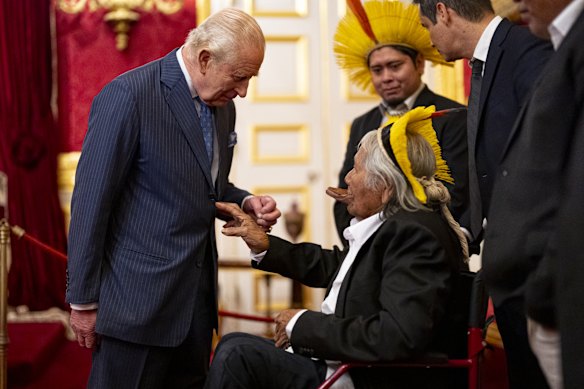
King Charles Hosts Indigenous Leaders Marking 40 Years Since Uluru Handover
LONDON - King Charles III hosted a reception in London Thursday bringing together Indigenous leaders from Brazil and Australia to commemorate the 40th anniversary of the handover of Uluru to the Anangu people, its customary owners. The event underscored the king’s longstanding commitment to environmental issues and Indigenous rights, occurring weeks before a key United Nations climate summit in Brazil.
The gathering, deliberately avoiding emphasis on colonial history, marks a notable milestone in land rights recognition and highlights the evolving relationship between the British monarchy and Indigenous communities. The handover of Uluru – also known as Ayers Rock – followed decades of advocacy and legal challenges, culminating in a 1983 amendment to the Aboriginal Land Rights (Northern Territory) Act.This transfer established a precedent for Indigenous land management and self-determination, a model increasingly relevant as global discussions around climate change and conservation intensify.
King Charles’s reunion with Brazilian Indigenous chief Raoni Metuktire, whom he first met in the 1980s during Metuktire’s fight against deforestation in the Amazon rainforest, symbolized the interconnectedness of these issues.The King has consistently championed action to reduce carbon emissions,and the upcoming UN climate summit in Brazil is expected to address the critical role of Indigenous land stewardship in preserving vital ecosystems.
Uluru-Kata Tjuta National Park, a UNESCO World Heritage site, attracts over 250,000 visitors annually. Prior to the 1983 handover, the Northern Territory government resisted Anangu claims to the land, despite the passage of the Aboriginal Land Rights (Northern territory) Act in 1976, which allowed claims based on proven traditional ownership.
the site’s colonial history began with explorer William Gosse, born in Hertfordshire, England in 1842, who led an expedition to central Australia in 1873 and named the landmark Ayers Rock after then-Premier of South Australia, Sir Henry Ayers. The event in London signifies a shift from that history toward a future built on respect for Indigenous sovereignty and environmental sustainability.
