
Israel Demolishes Gaza Settlements Amid War Crimes Allegations
Thousands of structures razed as legal experts question military necessity
Massive destruction across Gaza has seen entire towns leveled in recent weeks, with Israel’s military carrying out extensive demolitions. The scale of the destruction has prompted human rights lawyers to suggest potential war crimes under international humanitarian law.
Widespread Destruction Documented
Satellite imagery and verified footage reveal large-scale demolitions targeting residential buildings, schools, and infrastructure in areas under Israeli “operational control.” Analysis by academics indicates the destruction is heavily concentrated in the Rafah region, with significant demolitions also occurring in farming communities like Khuza’a and Abasan al-Kabira.
Legal Scrutiny of Operations
Experts argue that controlled destruction of civilian property is broadly prohibited during armed conflict. Eitan Diamond, a senior legal expert at the Diakonia International Humanitarian Law Centre, stated that justifications for such destruction are limited to absolute military operational necessity.
“International humanitarian law prohibits such controlled destruction of civilian property during armed conflict, except under narrow conditions of absolute military operational necessity,” Mr Diamond said. “Destruction of property because of concerns or speculations about its possible future use (for example, that it will be used to launch attacks in the future) falls well outside this exception.”
—Eitan Diamond, Senior Legal Expert, Diakonia International Humanitarian Law Centre
Professor Janina Dill of the Oxford Institute for Ethics, Law & Armed Conflict emphasized that an occupying power’s duty is to administer a region for the population’s benefit, which she finds incompatible with rendering territory uninhabitable.
Israeli Defense: Tactical and Safety Concerns
Conversely, some analysts defend the Israeli Defense Forces’ (IDF) actions. Prof Eitan Shamir, director of the BESA Center For Strategic Studies, noted that many demolished buildings were already ruined by prior shelling, posing safety risks to returning civilians, particularly during inclement weather.
“The area is a combat zone. Even when a building has been entered and cleared by the IDF, once the Israelis exit it, the terrorists often return to plant bombs or hide inside to shoot at them.”
—Prof Eitan Shamir, Director, BESA Center For Strategic Studies
The IDF maintains it operates in accordance with international law, citing Hamas’s alleged concealment of military assets within civilian areas as a necessity for its actions.
Creating ‘Security Zones’ and Buffer Areas
The demolitions extend to creating extensive “security zones” and corridors, including one separating western from eastern Khan Younis. This aligns with an analysis by Adil Haque of Rutgers Law School, who suggested the IDF might be establishing permanent “security zones.”
Reports indicate that the IDF has received dozens of D9 bulldozers, potentially increasing demolition capacity. Advertisements for demolition contractors in Gaza have also been widely shared on Israeli social media platforms, specifying work areas such as the “Philadelphi Corridor” and the “Morag Axis.”
An edited Facebook post reads: “Hiring excavator operators (40 tons) for a building demolition project in the Gaza Strip”. In a bullet point list: “Daily wage 1200 shekels ($358, £267) after taxes. Includes housing and food. Option for a private car. Immediate work – excellent conditions for those who qualify. Previous experience and appropriate permission required”. And it adds: “For details – leave a message with your full name and phone number. We will get back to you as soon as possible”. Some personal details in the image have been blurred.
— World News (@WorldNews) July 18, 2025
A BBC Verify investigation in August 2024 found that over 1,200 buildings had been demolished in Gaza by Israel since the conflict began, impacting civilian infrastructure significantly. For residents like Moataz Yousef Ahmed Al-Absi from Tel al-Sultan, the destruction has meant the complete loss of their homes and future prospects.
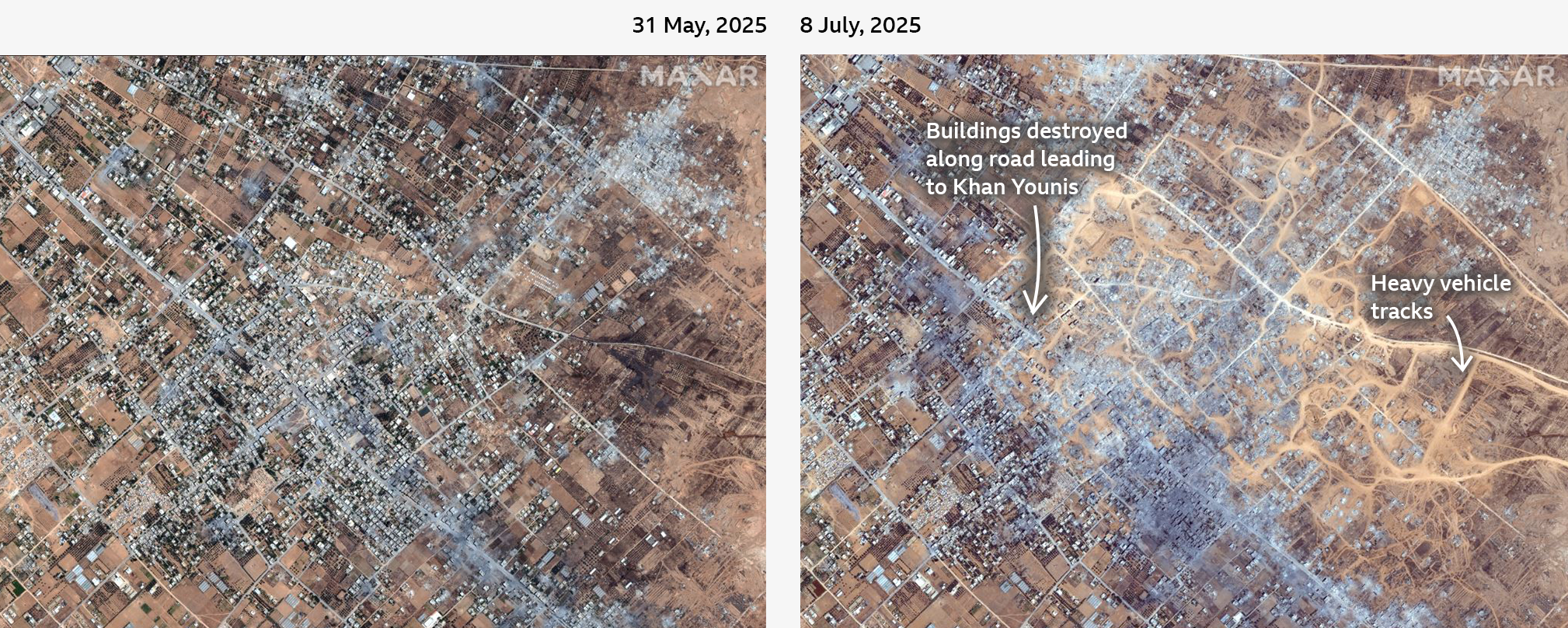
The ongoing demolitions continue without apparent immediate plans for reconstruction, raising further concerns about the long-term impact on the civilian population.
