
## Interstellar Objects May Accelerate Planet Formation, New Research Suggests
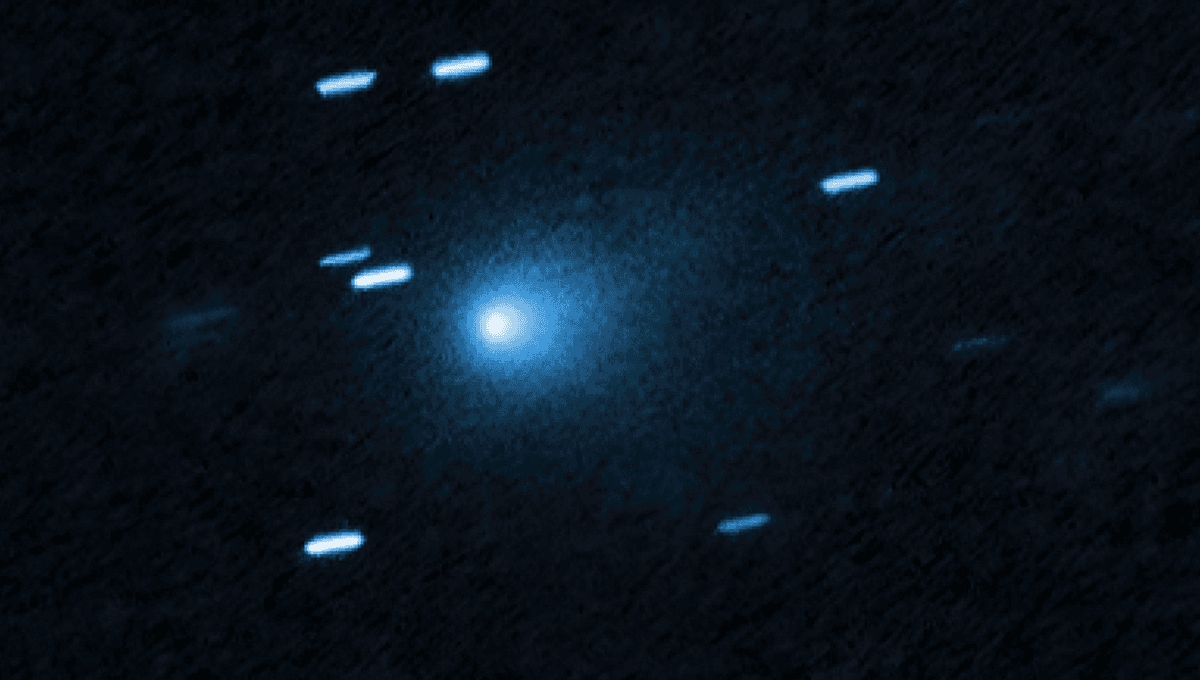
Recent research presented at the EPSC-DPS2025 conference proposes that interstellar objects (ISOs), like 3I/Atlas, could play a crucial role in jumpstarting planet formation, notably around higher-mass stars. This idea addresses existing challenges in planetary formation models, specifically the timescale required for planet advancement and the difficulty in explaining the growth of objects larger than a meter in size within protoplanetary disks.
Current models estimate terrestrial-type planets require approximately 106 years to form, with an additional 105 years needed for gas giants to accumulate their gaseous atmospheres. Though, observations of young star clusters reveal that protoplanetary disks typically have lifetimes of only 1-3 million years for both dust and gas – a discrepancy that has puzzled scientists.
A key hurdle in planet formation is the behavior of particles larger than a meter. Simulations indicate these “boulders” tend to bounce off each other or shatter upon collision, hindering their growth into larger planetary bodies. Researchers Pfalzner and Bannister suggest that ISOs could circumvent this problem by acting as “seeds” for faster and more efficient planet formation.
These interstellar objects, drawn towards stars by gravity – with higher-mass stars attracting more – could provide a site for *nucleation*, essentially offering larger, more robust cores for planetesimals to accrete onto. Unlike smaller particles,these larger “seeds” are less likely to fragment or bounce during collisions,accelerating the planet-forming process.
“Interstellar objects might potentially be able to jump start planet formation, in particular around higher-mass stars,” stated Pfalzner. “Interstellar space would deliver ready-made seeds for the formation of the next generation of planets.”
The theory also offers a potential explanation for the observed rarity of gas giants around smaller, M-dwarf stars. Moreover, it addresses the issue of gas giant formation around Sun-like stars, where the relatively short lifespan of protoplanetary disks (around 2 million years) may not be sufficient for customary formation models.
The researchers conclude that planet formation was likely slower in the earliest generations of stars, as fewer ISOs would have been available. While the original ISO material would eventually be dispersed through planetary differentiation – representing less than 0.1 percent of a terrestrial planet’s mass – it could have served as the initial core for many young planets.
The team emphasizes the need to incorporate ISOs into future planetary formation models and calls for further study of these objects to test this intriguing hypothesis. if confirmed, this research suggests that planets like Earth may have, at least in part, interstellar origins.
