
Track the Titans: Voyager 1, Webb & Other Spacecraft Visible in October Skies
For stargazers this October, the cosmos offers more than just constellations - it’s possible to pinpoint the locations of some of humanity’s most enterprising spacecraft, including Voyager 1 and the James Webb Space Telescope. While invisible to the naked eye, knowing where these robotic explorers reside provides a tangible connection to ongoing missions expanding our understanding of the universe.
Locating these spacecraft isn’t about seeing them, but appreciating their immense distances and the continuous flow of data they send back to Earth. This exercise highlights the scale of space exploration and the ingenuity required to maintain communication with probes billions of miles away. As new discoveries are made by these missions, understanding their positions reinforces the ongoing narrative of human curiosity and technological achievement.
Voyager 1,currently over 14.9 billion miles from Earth, can be approximated in the night sky by first locating the constellation Ophiuchus close to the western horizon in the hours following sunset in October. Find the binary star system Rasalhague and its neighbor Kappa ophiuchi; Voyager 1’s approximate position lies halfway along the imaginary line connecting these two stars. The spacecraft is embedded among the stars of Ophiuchus,with Hercules to its right and Scutum to its left.
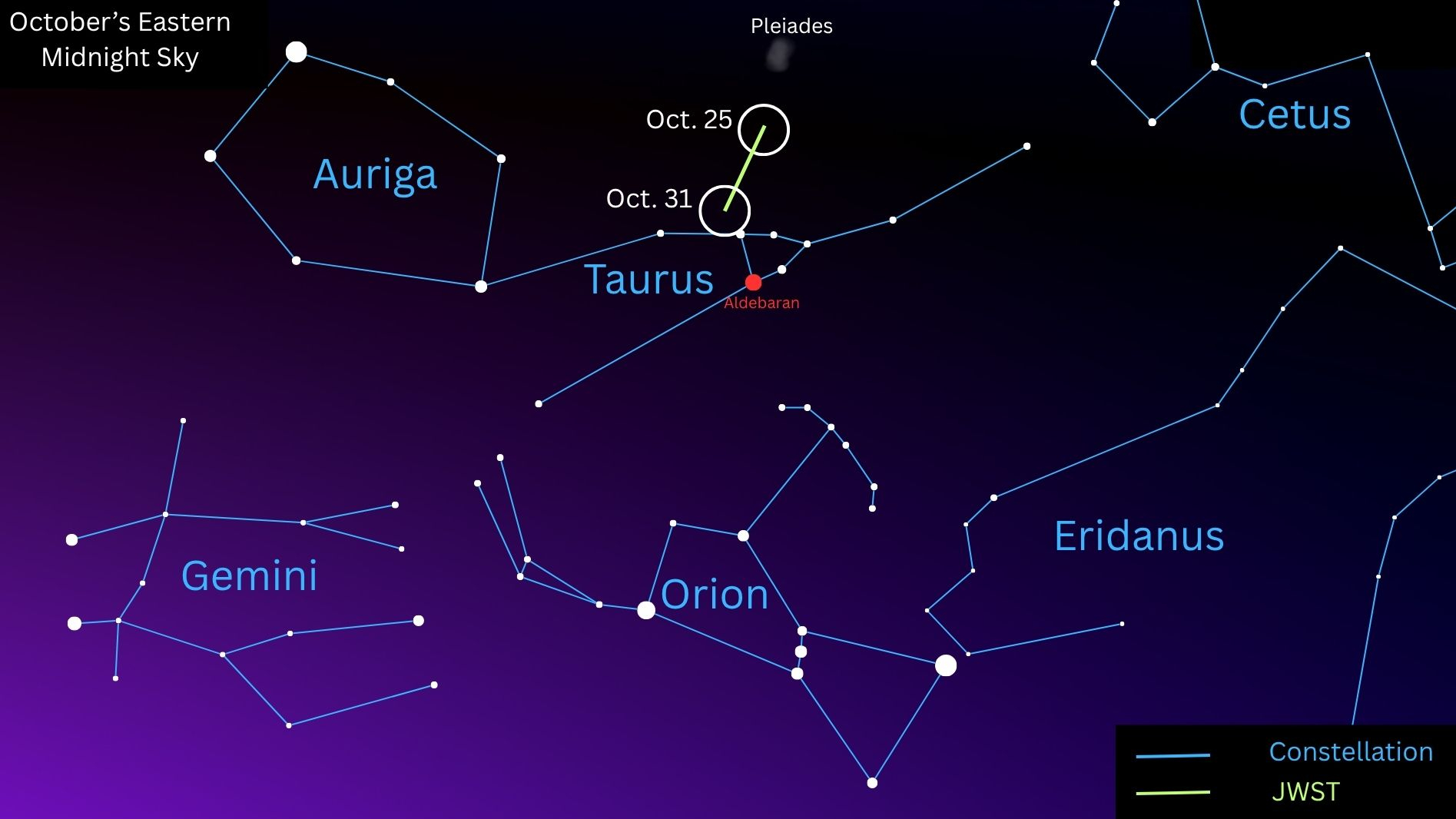
The James Webb Space Telescope, orbiting the Sun approximately 1 million miles from Earth, isn’t visible from Earth-based telescopes in the customary sense. However, its position can be tracked online using tools that predict its location relative to the sun. As of October 2023, Webb is positioned in its halo orbit around the second Lagrange point (L2), a gravitationally stable location ideal for observing the infrared universe.
Other spacecraft with trackable positions include:
* New Horizons: Over 8 billion miles from Earth, New Horizons is currently beyond Pluto and studying the Kuiper Belt. Its location is also trackable online.
* Pioneer 10 & 11: Though communication has been lost with both probes, their trajectories are well-understood, and their approximate locations can be determined. Pioneer 10 is over 12 billion miles from Earth, while Pioneer 11 is over 9 billion miles away.
* Mars Reconnaissance Orbiter (MRO): Currently orbiting Mars, MRO’s position is constantly changing as it surveys the Red Planet. Its location can be determined based on its orbital parameters.
Anyone interested in sharing their astrophotography related to spacecraft locations can submit photos and comments to spacephotos@space.com.

