
Great Barrier Reef Faces Record Coral Loss
Massive Decline Follows Unprecedented Heat Stress
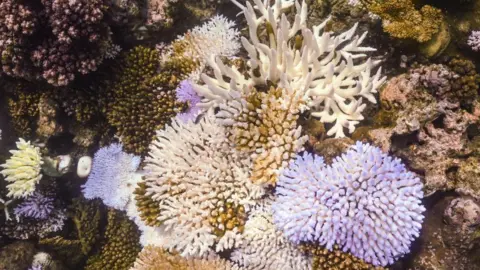
Record-breaking annual losses have devastated large sections of the Great Barrier Reef, with scientists pinpointing climate-driven heat stress as the primary culprit for the widespread coral bleaching.
Unprecedented Coral Bleaching Strikes
New findings from the Australian Institute of Marine Science (AIMS) reveal that both the northern and southern parts of the iconic reef endured their most extensive coral bleaching events in nearly four decades of record-keeping. This widespread damage occurred between August 2024 and May 2025.
The reef, a 2,300km natural wonder supporting immense biodiversity, is suffering the consequences of unusually warm ocean temperatures. This heat stress, a direct result of climate change, is overwhelming the coral’s ability to survive.
A Reef at a Tipping Point
AIMS researchers warn that the Great Barrier Reef may be approaching a critical tipping point. The frequency and severity of damaging events mean coral may not have sufficient time to recover between environmental catastrophes, leading to a “volatile” future for this vital ecosystem.
Coral bleaching occurs when marine organisms become stressed by overly warm water, causing them to expel the symbiotic algae that give them their color and food source. If waters remain elevated by 1C (1.8F) above their thermal limit for two months, coral is likely to die. An increase of 2C can be fatal within just one month.
In a concerning first, Australia’s second-largest reef, Ningaloo on the west coast, also experienced repeated bleaching this year, coinciding with the Great Barrier Reef’s events.
Climate Change Fuels Devastation
While tropical cyclones and outbreaks of the coral-eating crown-of-thorns starfish have also impacted reef health, AIMS researchers emphasize that climate change is the dominant factor. The report indicates that the reef has “experienced unprecedented levels of heat stress.”
Recovery for damaged coral is a lengthy process, potentially spanning several years, and is dependent on future coral reproduction and minimal further environmental disturbances.
Dr Mike Emslie, AIMS research lead, noted that Acropora corals, which are particularly vulnerable to heat and are a favored food for starfish, are the “fastest to grow and are the first to go.” He added, “The Great Barrier Reef is such a beautiful, iconic place, it’s really, really worth fighting for. And if we can give it a chance, it’s shown an inherent ability to recover.”
Efforts to Combat Threats
There has been some success in managing threats, particularly with the Australian government’s program to cull crown-of-thorns starfish. Over 50,000 starfish have been killed through direct injection. The AIMS report noted the absence of significant outbreaks on the Central GBR in 2025 due to these control measures.
Crown-of-thorns starfish are native but have seen population surges since the 1960s, with agricultural runoff suspected as a primary cause. This nutrient enrichment likely fuels their increased numbers.
Urgent Climate Action Needed
Richard Leck from WWF highlighted the reef as “an ecosystem under incredible stress,” expressing concern about the reef’s diminishing capacity to bounce back. He warned that without swift and ambitious climate action, the Great Barrier Reef risks suffering the same fate as other coral reefs globally that are already beyond recovery.
UNESCO has previously warned that the Great Barrier Reef, a World Heritage site for over 40 years, is “in danger” due to warming seas and pollution.
