
Global Markets Rally: Stocks Climb Amid Inflation Data and Geopolitical Shifts
Table of Contents
global financial markets demonstrated resilience during the second week of August, posting collective gains driven by encouraging economic data and evolving monetary policy outlooks. Investors reacted positively to new indicators, signaling potential shifts in central bank strategies.
Wall Street Advances
U.S. stock indices rose throughout the week, with the Dow Jones Industrial Average leading the charge. Positive inflation and retail sales figures bolstered optimism regarding potential interest rate reductions by the Federal Reserve in the coming months.
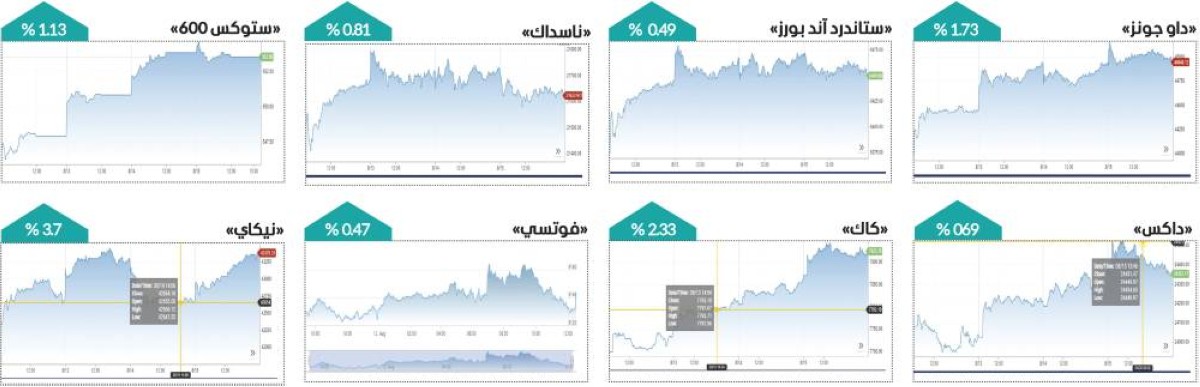
The Dow Jones Industrial Index increased by 1.73%, closing at 44,946.12,up from 44,175.61 the previous week. The Standard & Poor’s 500 index also saw weekly gains, rising 0.49% to end trading at 6,449.80 points, compared to 6,389.45 points. The Nasdaq Composite increased by 0.81% to 21,622.977 points, a rise from 21,450.02 points.
July retail sales data,released Friday,showed a 0.5% increase with sales excluding automobiles rising 0.3%, aligning with analyst expectations. However, consumer confidence dipped in early August, reflecting ongoing concerns about inflation, according to a University of Michigan survey, which registered a reading of 58.6 points-a 5% decrease from July and the first decline in four months.
Notable stock performances included Amazon, with weekly gains exceeding 3.5%, and increases of approximately 2% for shares of AT&T and 1% for Apple. Conversely,shares of Invitae fell roughly 1.2% following concerns raised by China regarding the use of american H20 foil.
Did You Know?
Recent agreements suggest the U.S. administration may receive 15% of sales from Chinese artificial intelligence chips.
European Markets Show Strength
Major European indices also experienced collective gains. The Stoxx 600 index climbed approximately 1.13%, closing at 553.56 points, up from 547.40 points the prior week. While the index reached a multi-month high on Friday, gains were tempered by a decline in technology shares.
Germany’s DAX index rose 0.69%, finishing the week at 24,359.30 points, compared to 24,193.3 points.France’s CAC index increased by 2.33% to 7,923.45 points, up from 7,743.00 points. The UK’s FTSE index gained 0.47% to 9,138.90 points, compared to 9,095.7 points.
Market anticipation surrounded a summit between U.S. President Donald Trump and Russian President Vladimir Putin in Alaska, focused on the war in Ukraine. The absence of Ukrainian President Volodymyr Zelenskyy and European officials sparked concerns about potential compromises at Europe’s expense.
Asian Markets Positive, Commodities Mixed
In Tokyo, the Nikkei index achieved a new closing high, supported by positive domestic economic data despite ongoing trade tensions.Japan’s gross domestic product increased by 0.3% in the second quarter, exceeding expectations and bolstering investor confidence. The index closed at 43,378.31 points, a weekly gain of about 3.7% from 41,820.48 points.
Oil and gold prices declined amid geopolitical uncertainties and anticipation of the Trump-Putin summit. Brent crude futures decreased by 1.11% to $65.85 a barrel, down from $66.59 the previous week.American crude futures fell by 1.7% to $62.80 a barrel, compared to $63.88. Gold futures also experienced weekly losses, dropping approximately 3% to $2,382.6 per ounce.
Key Market Data – week Ending August 17, 2025
| Index | Weekly Change | Closing Value |
|---|---|---|
| Dow Jones industrial Average | +1.73% | 44,946.12 |
| S&P 500 | +0.49% | 6,449.80 |
| Nasdaq Composite | +0.81% | 21,622.977 |
| Stoxx 600 | +1.13% | 553.56 |
| nikkei 225 | +3.7% | 43,378.31 |
Pro Tip:
Monitoring geopolitical events and their potential impact on commodity prices is crucial for investors.
What factors do you believe will most influence market direction in the coming weeks? How might evolving U.S.-Russia relations impact European economies?
The recent market rally reflects a broader trend of investor optimism driven by easing inflation concerns and expectations of potential interest rate cuts.However, geopolitical risks and ongoing supply chain disruptions remain important factors that could impact market stability. understanding thes underlying dynamics is crucial for long-term investment strategies. According to a report by the International Monetary Fund (IMF), global economic growth is projected to moderate in the coming years, highlighting the importance of diversification and risk management [[1]].
Frequently Asked Questions
- What is driving the recent stock market gains? The gains are primarily driven by positive economic data,notably regarding inflation and retail sales,and expectations of potential interest rate cuts.
- How are geopolitical events impacting the markets? Geopolitical events, such as the U.S.-Russia summit, create uncertainty and can influence commodity prices and investor sentiment.
- What is the outlook for oil prices? The outlook for oil prices remains uncertain, influenced by geopolitical factors and global demand.
- What is the significance of the Nikkei’s performance? The Nikkei’s strong performance indicates improving economic conditions in Japan and renewed investor confidence.
- What should investors do in this environment? Investors should focus on diversification, risk management, and staying informed about economic and geopolitical developments.
Disclaimer: This article provides general financial information and should not be considered investment advice. Consult with a qualified financial advisor before making any investment decisions.
We hope you found this analysis insightful. Share this article with yoru network, leave a comment below, or subscribe to our newsletter for more in-depth market coverage!
