
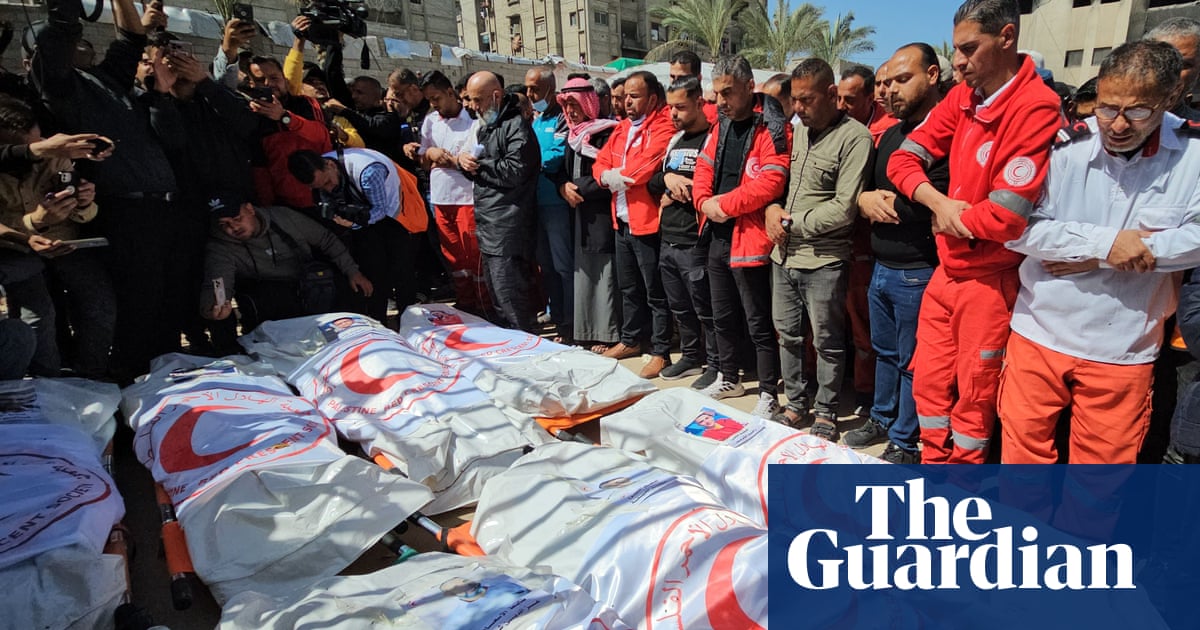
Gaza: Evidence Mounts of potential war Crime Against Palestinian Medics
Eyewitness accounts and UN investigations suggest Israeli forces may have committed war crimes against Palestinian paramedics in Rafah, Gaza.
Disturbing accounts are emerging from Gaza, alleging that Israeli forces may have committed war crimes against Palestinian paramedics and rescue workers. Eyewitness reports indicate that some of the 15 individuals, whose bodies were recovered from a mass grave nine days after their deaths, showed signs of being restrained and executed. This incident, which occurred on March 23 in the al-Hashashin district of Rafah, is now under intense scrutiny by international bodies.
These accounts bolster existing allegations from senior officials within the Palestinian Red Crescent, the Palestinian Civil Defense, and the Gaza health ministry. These organizations claim that some victims were allegedly shot after being detained and restrained by Israeli troops. The implications of these allegations are significant, potentially leading to further investigations by the International Criminal Court (ICC) and increased international pressure on Israel.
The events unfolded after the Israeli government ended a two-month ceasefire and resumed its military campaign against Hamas and other militant groups in Gaza on March 17. This resumption included heavy aerial bombing and ground operations. Compounding the humanitarian crisis, residents of Rafah were ordered to evacuate on Monday, preceding anticipated Israeli ground operations.
The ICC has already issued arrest warrants for war crimes in November against Israeli Prime minister Benjamin Netanyahu and former Defense minister Yoav Gallant. The ICC prosecutor has stated that investigations into alleged atrocities committed by both Israeli forces and Hamas are ongoing. This context underscores the gravity of the current allegations and the potential for further legal action.
The victims are believed to have been killed on March 23. Two paramedics were killed in the early hours when their ambulance was struck by Israeli fire while en route to assist those injured in an earlier airstrike. A convoy of ambulances and civil defense vehicles, carrying 13 individuals, was then dispatched to recover the bodies of their fallen colleagues. tragically, this convoy also came under attack. Among the dead was a UN employee.A Red Crescent paramedic,Assad al-Nassasra,remains missing,adding another layer of concern to the situation.
The United Nations has reported that the ambulances and other vehicles were deliberately buried in sand by bulldozers, alongside the bodies of the deceased. This action appears to be an attempt to conceal the killings. Video footage taken by the UN recovery team reveals a crushed UN vehicle, ambulances, and a fire truck, all flattened and buried in the sand by the Israeli military. this evidence has sparked outrage and demands for a thorough inquiry.
“This is a huge blow to us … These people were shot,” Jens Laerke, a spokesperson for the UN aid coordination office, said on Tuesday. “Normally we are not at a loss for words and we are spokespeople, but sometimes we have difficulty finding them. This is one of those cases.”
In response to these allegations, the Israeli military stated that its “initial assessment” indicated that troops opened fire on vehicles ”advancing suspiciously toward IDF troops without headlights or emergency signals.” The IDF has also claimed, without providing evidence, that Hamas fighters and other militants were using the ambulances for cover. These claims are being met with skepticism, given the eyewitness accounts and the UN’s findings.
As of now, the Israel Defense Forces have not responded to specific questions regarding the burial of the bodies and vehicles, nor have they addressed the allegations that some victims were shot after being detained. This silence has fueled further speculation and calls for openness.
Dr. bashar Murad, the Red Crescent’s director of health programs in Gaza, reported that at least one of the recovered paramedics had his hands tied. He also stated that one of the paramedics was on a call to the ambulance dispatcher during the attack. This detail provides a chilling glimpse into the final moments of the victims.
According to Dr. Murad, gunshots fired at close range could be heard on the call, along with the voices of Israeli soldiers speaking in Hebrew and ordering the detention of at least some of the paramedics. This audio evidence, if verified, could be crucial in establishing the truth of the allegations.
“The gunshots were fired from a close distance. They could be heard on the call between signal officer and of the medical crews that survived and phoned the ambulance center for help. The soldiers’ voices were clearly audible in Hebrew and very close, as well as the sound of the gunfire.”
Dr. Murad further stated that the dispatcher overheard the soldiers saying, “Gather them at the wall and bring some restraints to tie them.” He clarified that the call was not recorded. This lack of a recording presents a challenge for investigators, but the testimony of the dispatcher remains a significant piece of evidence.
Mahmoud Basal, a spokesperson for the Palestinian Civil Defence in Gaza, corroborated the accounts, stating that the bodies had at least 20 gunshot wounds each. He also confirmed that “at least one of them had their legs bound.” These details paint a grim picture of the circumstances surrounding the deaths.
Gaza’s health ministry released a statement on Monday, asserting that the paramedics “were executed, some of them handcuffed and had sustained head and chest injuries. They were buried in a deep hole to prevent their identities from being identified.” This statement underscores the severity of the accusations and the demand for justice.
The IDF issued evacuation orders covering most of Rafah on Monday, signaling a potential major ground operation just eight days after the paramedics and rescue workers were killed. This timing has raised concerns that the operation may be intended to further obscure the events of March 23.
The Palestinian red Crescent president, Dr. Younis al-Khatib, stated that the IDF impeded the collection of the bodies for several days. The IDF claimed that it facilitated the evacuation of bodies as soon as “operational circumstances” allowed. This discrepancy highlights the ongoing tensions and conflicting narratives surrounding the incident.
“the bodies were recovered with difficulty as they were buried in the sand, with some showing signs of decomposition,” the Red Crescent reported. This detail underscores the challenges faced by recovery teams and the potential loss of crucial evidence due to the delay.
Autopsies have been conducted at the Nasser hospital in Khan Younis, and a full report is expected to be delivered to the Gaza health ministry within 10 days, according to hospital sources. The findings of these autopsies will be critical in determining the cause of death and providing further evidence for potential war crimes investigations.
Gaza’s Paramedic Massacre: Unpacking the Accusations of War Crimes and the Fight for Justice
World-Today-News.com Senior Editor: We’re here today with Dr. Arwa Khalil,a leading expert in international human rights law,to shed light on the deeply disturbing reports alleging war crimes against Palestinian paramedics in Gaza. Dr. Khalil,thank you for joining us. To begin,what is the most shocking aspect of this situation,and what legal avenues are available for seeking justice?
Dr.Arwa Khalil: Thank you for having me. The most shocking aspect is the blatant disregard for the core principles of international humanitarian law, specifically the protection afforded to medical personnel during armed conflict. This attack, if proven, on clearly identifiable medical professionals performing their humanitarian duty constitutes a grave breach of the laws of war. The accounts of execution,restraint,and the purposeful burial of the bodies with their vehicles are particularly egregious. As for legal avenues, we’re looking at multiple possibilities.
International Criminal Court (ICC): the ICC already has an open investigation into the situation in Palestine. This incident could be added to that investigation, potentially leading to charges against individuals involved.
National Courts: In certain jurisdictions, worldwide jurisdiction principles might allow for the prosecution of individuals suspected of war crimes, irrespective of where they occurred.
International Pressure: Advocacy groups,human rights organizations,and international bodies like the UN can play a role in applying pressure on the involved parties to conduct a more thorough investigation.
Fact-Finding Missions: Independent fact-finding missions can be commissioned to establish the truth and gather evidence,strengthening the case for justice.
World-Today-News.com Senior Editor: The article mentions troubling evidence – including reports of restrained victims, gunshot wounds, and the UNS reporting of deliberate concealment of the attack through the burial of ambulances. Can you elaborate on how this impacts the likelihood of these accusations being classified as war crimes?
Dr. Arwa Khalil: The presence of these elements dramatically increases the likelihood of the accusations qualifying as war crimes. These are highly concerning details that may violate international law, specifically the laws and customs of war, which prohibit the intentional targeting of medical personnel and the commission of acts of violence.
Targeting of Medical personnel: Deliberately targeting ambulances or medical workers, who are protected under international law, is a serious war crime.
Execution and Targeting of the Vulnerable: If evidence confirms that paramedics were restrained and executed, this qualifies as a war crime and an act of murder.
Concealment of Evidence: Attempting to bury vehicles and bodies to conceal the outcome of the shooting complicates efforts of investigations and can carry its own legal ramifications.
World-Today-News.com Senior Editor: The article details how the IDF has defended its position by stating that troops opened fire on suspicious vehicles. How do you approach these sorts of claims in the context of international human rights investigations? Is this always the only part of the story?
Dr.Arwa Khalil: It’s crucial to approach such claims with a high degree of skepticism and to employ a rigorous process to verify the facts independently. Whenever these types of claims occur, we must verify the following:
Conduct Independent Investigations: Independent human rights observers and groups must be granted full access to verify events.
Collect Witness Testimony: Eyewitness testimonies, especially medical professionals and other on-scene responders, are crucial for determining the sequence of events and the facts.
Evaluate Forensic Evidence: Any available digital evidence must be assessed to determine the events.
From the outlook of international humanitarian law, this is a obligation of the parties in the conflict, and that is the ultimate test of whether the claims hold up.
World-Today-News.com Senior Editor: The article states ther are claims that the bodies were buried in the sand by bulldozers. If proven, how would such acts be classified under international law and what are the potential implications for the perpetrators?
Dr. Arwa Khalil: If confirmed, the bulldozing of bodies to bury the victims and vehicles, along with the intent to conceal the killings, poses a grave violation of international law. Such actions may qualify as:
- War Crimes Against the Dead: A violation of the laws and customs of war involving a dead person. This is against the Geneva Conventions, which require respectful treatment of human remains.
- Evading the Investigations: The act of burying evidence can be construed as a deliberate act of obstructing justice.
- Violation of the Hague Convention: The deliberate destruction or concealment of evidence is a serious issue in a conflict involving an armed group protected by the Hague Convention.
The implications for the perpetrators could be severe, including potential prosecution by the International Criminal court (ICC) or in national courts. This can lead for convictions and potential imprisonment.
World-Today-News.com Senior Editor: The article emphasizes the importance of the autopsies being conducted. What are the main goals of these autopsies in the context of a potential war crimes investigation?
Dr. Arwa Khalil: The autopsies are critical.They are meant to achieve the following:
Establish the Cause of Death: To determine the specific cause of death and provide precise insights into the events.
Reveal Evidence of restraint or Execution: To search for evidence of gunshot wounds, bondage, and any other signs of trauma. This will give insights into the allegations of the paramedics being executed.
Gather Forensic Evidence: Any forensic evidence found at the site to clarify any questions regarding the events. This may include the discovery of bullet fragments that might assist investigators in tracing the origin of the shots.
World-Today-News.com senior Editor: Looking ahead, what are the most significant steps that need to be taken to seek justice in this case? What can the international community do to ensure accountability?
dr. Arwa Khalil: The most critical steps are to launch independent and impartial investigations that are open and clear. Here are other critical steps.
Investigate Claims of Brutality: review the allegations of brutality during the investigations.
protect the Evidence: To ensure all evidence is protected and not tampered with.
Respect the Rights of Survivors: Respect and offer assistance to all the survivors.
Encourage International Involvement: Invite the participation of international observers from the UN.
The international community can ensure accountability through all of the following areas:
Diplomatic Pressure: Through the UN Security Council resolutions to call for independent investigations.
Funding Aid: Through financing activities for all the inquiries to ensure that the investigations are accurate and thorough.
Impose Sanctions: Through the use of sanctions against individuals.
* Cooperate with the ICC: Cooperate with the ICC to determine any war crimes by supporting any investigation and issuing arrest warrants.
World-Today-News.com senior Editor: Dr. Khalil,thank you for providing your expert insights. It is a challenging situation, and we hope that the victims will be seen fairly and justice be served.
Dr. Arwa Khalil: Thank you for providing me with a platform to discuss this importent issue.
