
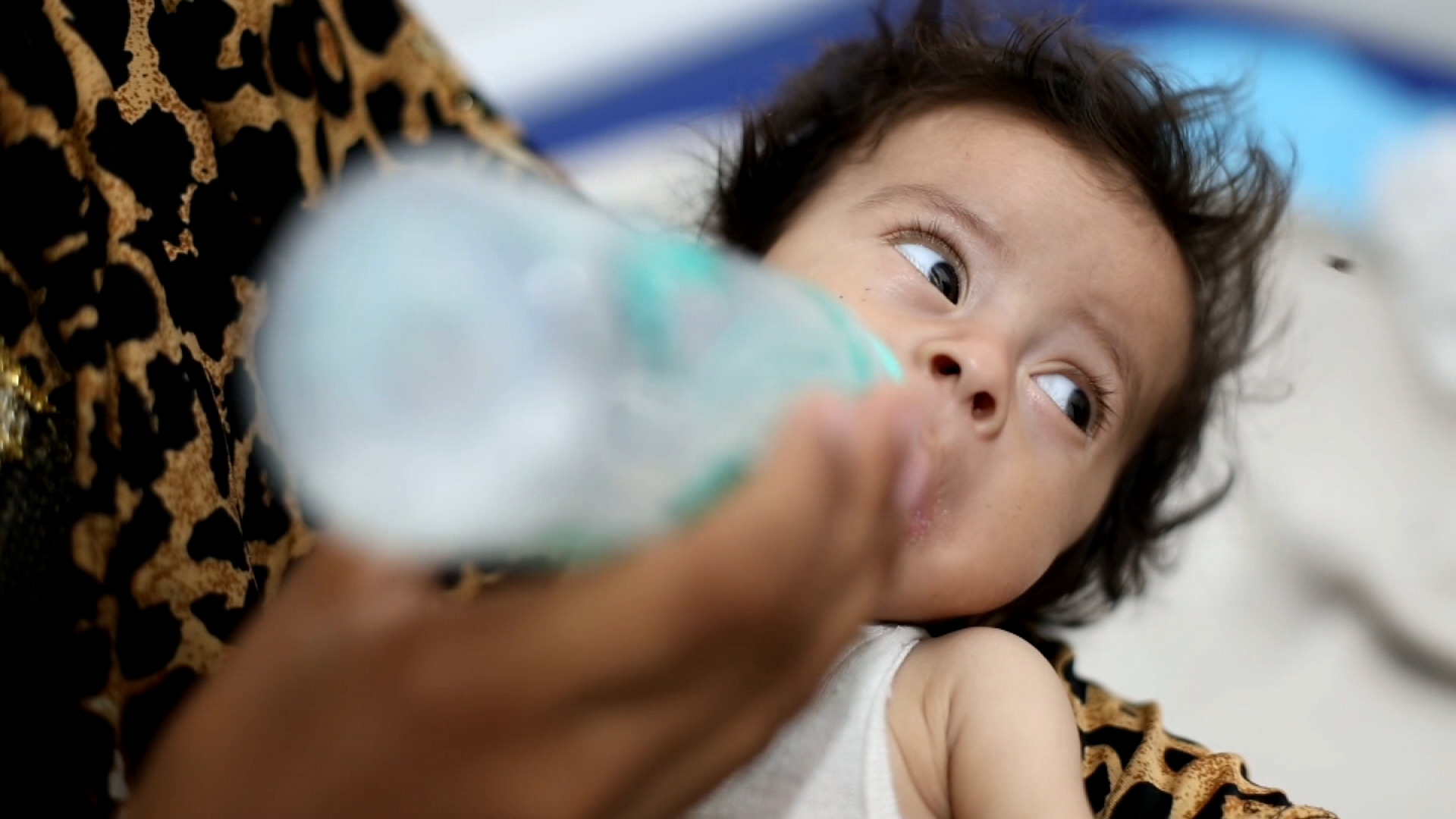
Gaza’s Children Face Malnutrition Crisis as Food Supplies Dwindle – UNifeed Report
Al-Awda Hospital, Gaza Strip – A growing number of children in the Gaza Strip are suffering from severe malnutrition, with cases now extending beyond the typical under-five demographic, according to a recent report from UNifeed. The crisis is driven by limited access to food and essential supplies, exacerbated by ongoing restrictions and rising commodity prices.
Four-month-old Shaher Al-Qra’ is one such case. His mother, Amneh Abu Autawy, describes a desperate situation. ”His weight is not increasing; the condition is very arduous, there’s no food, thus I don’t have any milk to breastfeed him, and there’s no food in general,” she explained.”Since I am not breastfeeding him, he has no immunity either, he catches infections very quickly.” Ms. Autawy visibly distressed, noted Shaher’s extreme weakness, stating, “If I hold him like this, he won’t be able to hold himself… Look at his hand; there’s no muscles, there’s nothing, he’s weak. Four-month-old babies can at least sit, unlike my baby he can’t even do that. His health condition is extremely bad.” She expressed deep fear for her son’s future, saying, “It’s getting worse and worse every day. Actually, what’s coming next is way worse than what we went through.”
Healthcare workers at Al-Awda Hospital are overwhelmed by the influx of malnourished patients, not only from children under five but increasingly from those aged five to twelve. Dr.Rana Abu Zaatir, Head of the Department of Therapeutic Nutrition at Al-Awda Hospital, confirmed this trend. “Large numbers of patients are coming to us from the southern Gaza Strip and from the southern areas. …we have started to face new numbers and new cases that we encounter over five years old. As a result, we have begun to receive cases of severe malnutrition with medical complications from five to twelve years old.We also have recently begun to receive cases from the age of two months to six months.”
The hospital utilizes Mid-Upper Arm Circumference (MUAC) measurements to quickly assess nutritional status, with a red circumference indicating severe acute malnutrition. Shaher’s MUAC measurement reflects the severity of his condition.
Dr. Abu Zaatir emphasized the interconnectedness of maternal and infant nutrition. “We are in constant need of larger quantities of specialized nutritional supplements for young children, and also pregnant and lactating women. Because it is a circle that all complement each other. If a pregnant woman suffers from malnutrition, there is a high possibility of miscarriage…This also leads to babies being born with a low birth weight…Furthermore, during breastfeeding, the mother may be unable to provide the baby with the optimal amount of breastmilk, which causes the baby to remain underweight.”
The consequences of the crisis are already devastating. Dr. Abu Zaatir stated, “There are large numbers of children and adults who have died due to malnutrition and its complications.” She warned of a looming disaster if the current situation persists. “Unfortunately, in the coming days and even in the coming period, if the crossings remain closed in this way and the prices of basic commodities continue to rise in this way, we will face a real disaster in the Gaza Strip due to malnutrition and the lack of sufficient food resources for a normal life for these people.”
