
Astronomers baffled by Unprecedented Gamma-Ray Burst, GRB 250702B
An unusually long and repeating gamma-ray burst, designated GRB 250702B, has astronomers puzzled due to its atypical behavior and potential origins. Detected initially in soft X-rays, teh burst was followed hours later by its brightest gamma-ray flash – a reversal of the typical sequence for such events.
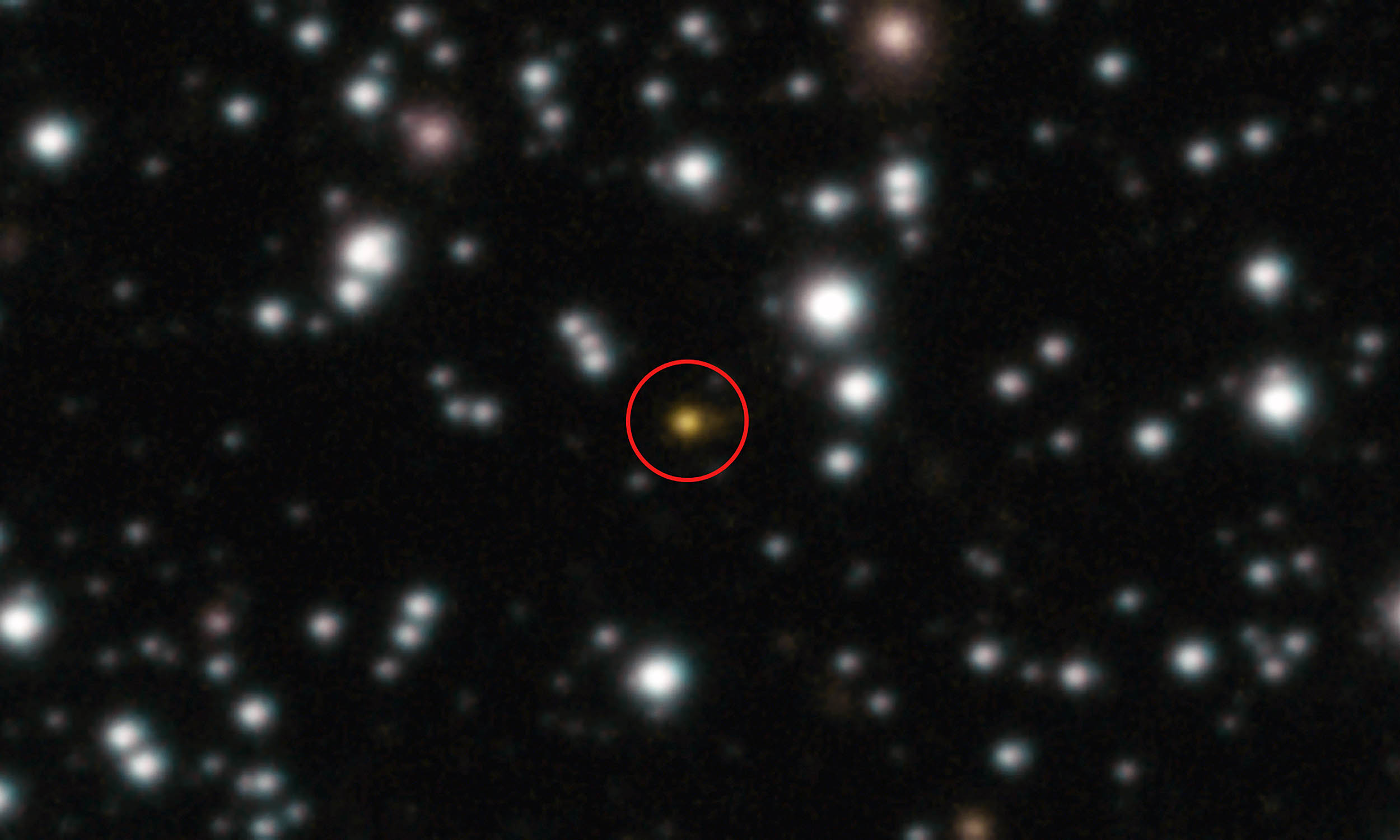
Observations from the European Southern Observatory’s Very Large telescope (VLT), utilizing the HAWK-I infrared camera, and NASA/ESA’s Hubble Space Telescope revealed the explosion appears to be nested within an elongated galaxy seen edge-on, crossed by a prominent dust lane. This dust lane aligns with strong X-ray absorption measurements.
The burst’s afterglow exhibited characteristics consistent with a standard jet interacting with surrounding gas, including quickly fading infrared light and a faint radio source detected by radio telescopes. However, the initial high-energy behavior doesn’t fit neatly into existing gamma-ray burst categories.
Researchers are considering several explanations, including a tidal disruption event involving a black hole. The host galaxy’s lack of a central supermassive black hole suggests an off-center, intermediate-mass black hole might potentially be a more likely source if a disruption event is the cause. The observed red color is attributed to dust absorbing blue light.
Scientists are now monitoring GRB 250702B for a potential drop in X-ray emissions as the jet shuts off, and a subsequent rise in radio emissions as the blast wave expands. They are also searching for a supernova, which would appear in the infrared weeks after the initial collapse, though dust may obscure the view. Spectroscopy will be used to determine the distance to the source and characterize its surrounding environment, establishing its energy budget and allowing for comparison to known events.
“We are still not sure what produced this, but with this research we have made a huge step forward towards understanding this extremely unusual and exciting object,” said researcher Martin-Carrillo.
the findings are published in The Astrophysical journal Letters.
