
European Space Agency’s Mars Orbiters Capture Interstellar Comet 3I/ATLAS During Rare Solar System Pass
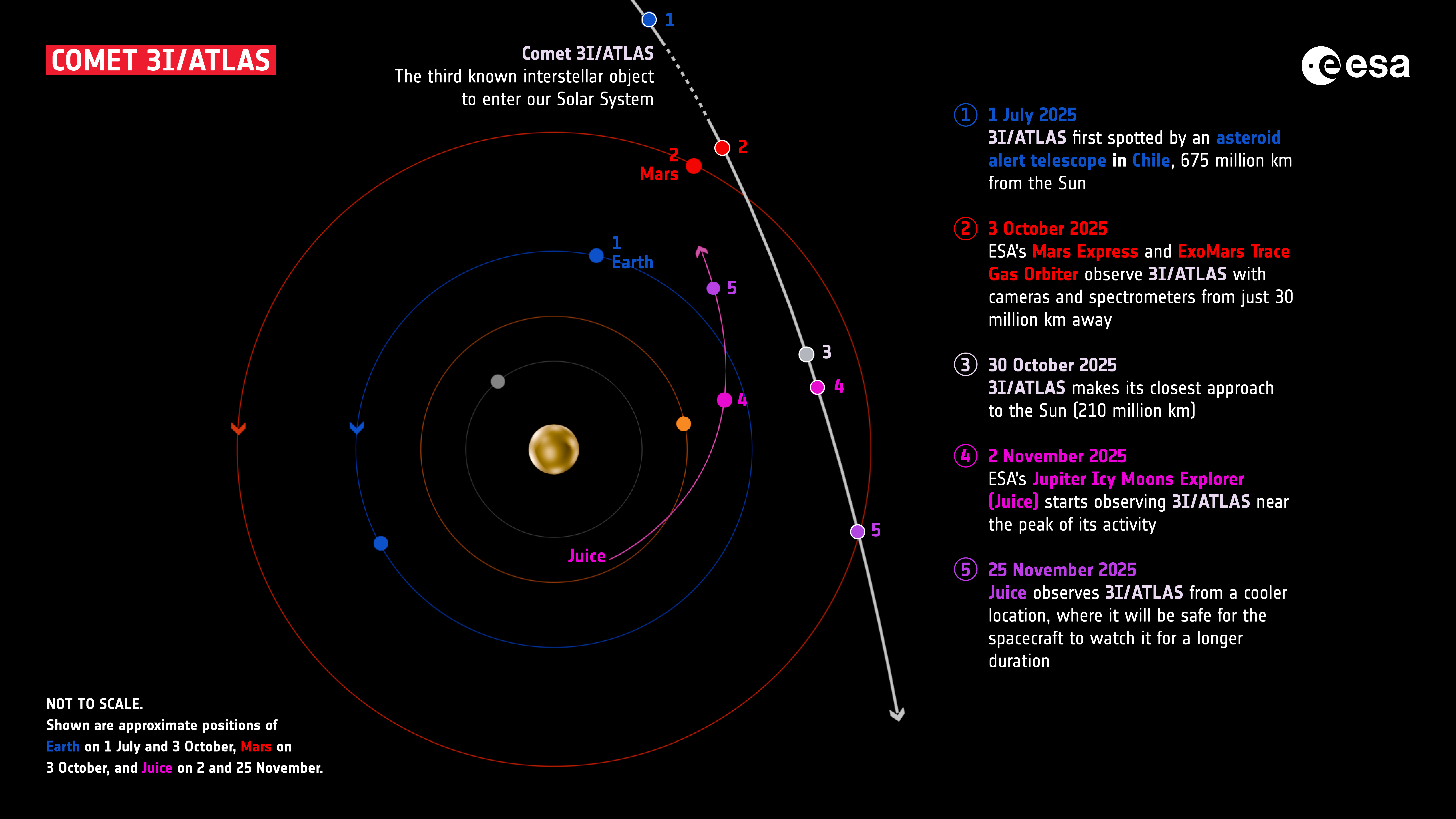
Mars – European spacecraft orbiting Mars have successfully observed interstellar comet 3I/ATLAS as it makes a historic journey through our solar system. The ExoMars Trace Gas Orbiter (TGO) and Mars Express captured data on the comet during it’s close flyby of the Red Planet on Oct. 3, offering a unique opportunity to study an object originating from outside our solar system.
3I/ATLAS,discovered in 2019,is only the third confirmed interstellar comet to visit our cosmic neighborhood. Its trajectory is bringing it closer to the sun than Earth,providing scientists with valuable insights into the composition and behavior of these rare visitors. The European Space Agency (ESA) coordinated a campaign to observe the comet as it passed Mars, leveraging the capabilities of its orbiting probes.
While scientists have yet to definitively resolve 3I/ATLAS in imagery from Mars Express, the TGO successfully observed the comet. The difference in observation quality stems from exposure times; Mars Express was limited to 0.5 seconds, while TGO utilized a five-second exposure.
“Though our Mars orbiters continue to make notable contributions to Mars science, it’s always extra exciting to see them responding to unexpected situations like this one,” said Colin Wilson, Mars Express and ExoMars project scientist at ESA. “I look forward to seeing what the data reveals following further analysis.”
Further observations are planned as 3I/ATLAS continues its journey. ESA’s JUICE probe, currently en route to Jupiter, will begin tracking the comet on Nov. 2, just days after its closest approach to the sun on Nov. 1 at a distance of 130 million miles (210 million km). Despite being farther from the comet than the Mars probes, JUICE is expected to obtain valuable data as 3I/ATLAS becomes more active closer to the sun.
The TGO reached Mars in 2016 with a mission to analyze the planet’s atmosphere for methane and other trace gases, while Mars Express has been orbiting the Red planet since 2003. These ongoing missions are now contributing to a broader understanding of interstellar objects and the solar system’s dynamic environment.
