
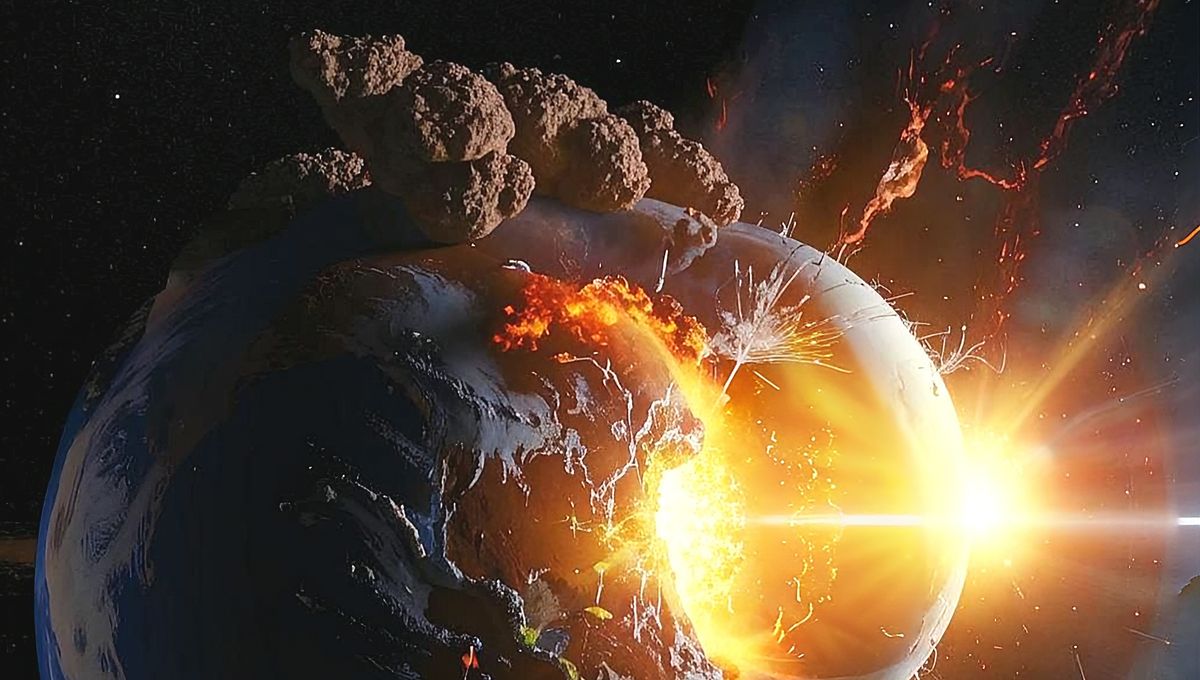
Earth’s Water & Potential for life May Be Thanks to a Mars-Sized Collision, New Research Suggests
Bern, Switzerland – A groundbreaking study published today in Science Advances proposes that a colossal impact with a Mars-sized object, theorized to have formed the Moon, is responsible for delivering the volatile elements – including water – that made Earth habitable. Researchers at the University of Bern utilized high-precision dating based on the radioactive decay of manganese-53 to refine the timeline and source of Earth’s life-giving ingredients.
For years, scientists have debated the origin of Earth’s water.While comets and asteroids were considered potential sources, this new research suggests a single, massive event was the primary delivery mechanism. The team’s analysis indicates the proto-Earth was initially a “dry rocky planet,” and it was the collision with the impacting object – dubbed Theia – that introduced the volatile elements necessary for life.
“Thanks to our results,we certainly know that the proto-Earth was initially a dry rocky planet. It can therefore be assumed that it was only the collision with Theia that brought volatile elements to Earth and ultimately made life possible there,” explained Dr. Tim lichtenberg, a co-author of the study, echoing the sentiment of lead researcher Dr. Andreas Kruttasch.
The manganese-53 isotope, with a half-life of approximately 3.8 million years, served as a precise “clock” to determine the timing of this crucial event. The study estimates the modern Earth is composed of roughly 90% material from the pre-collision proto-Earth, 10% from Theia, and 0.4% from later additions.
Crucially, the research suggests Theia likely formed beyond the Solar system’s ”snowline” – the distance from the sun where volatile compounds remain frozen. This location would have allowed Theia to accumulate a meaningful amount of water and other volatiles, which were then transferred to Earth during the impact. while much of this material would have vaporized in the intense heat of the collision, enough remained to create Earth’s oceans.
“If Kruttasch and Mezger are right, then the odds against a habitable planet were exceptionally long,” the report states. Researchers estimate the probability of such an event – a large impactor originating from beyond Mars - is “a million to one.”
This finding has significant implications for the search for life beyond Earth. According to Dr. Kees Welten, a co-author, “this makes it clear that life-friendliness in the universe is anything but a matter of course.” The study suggests planets capable of supporting complex life may be exceptionally rare,while simpler organisms might be more common on planets with limited resources,or abundant resources in frozen environments far from their stars.
The research team acknowledges the possibility of flaws in their reasoning and encourages scrutiny of their findings, publishing the study as open access to facilitate further investigation. This work offers a compelling new perspective on the unique circumstances that allowed life to flourish on Earth, and raises profound questions about our place in the universe.
