
Interstellar Comet 3I/ATLAS Imaged by mars Orbiter in Historic Close Encounter
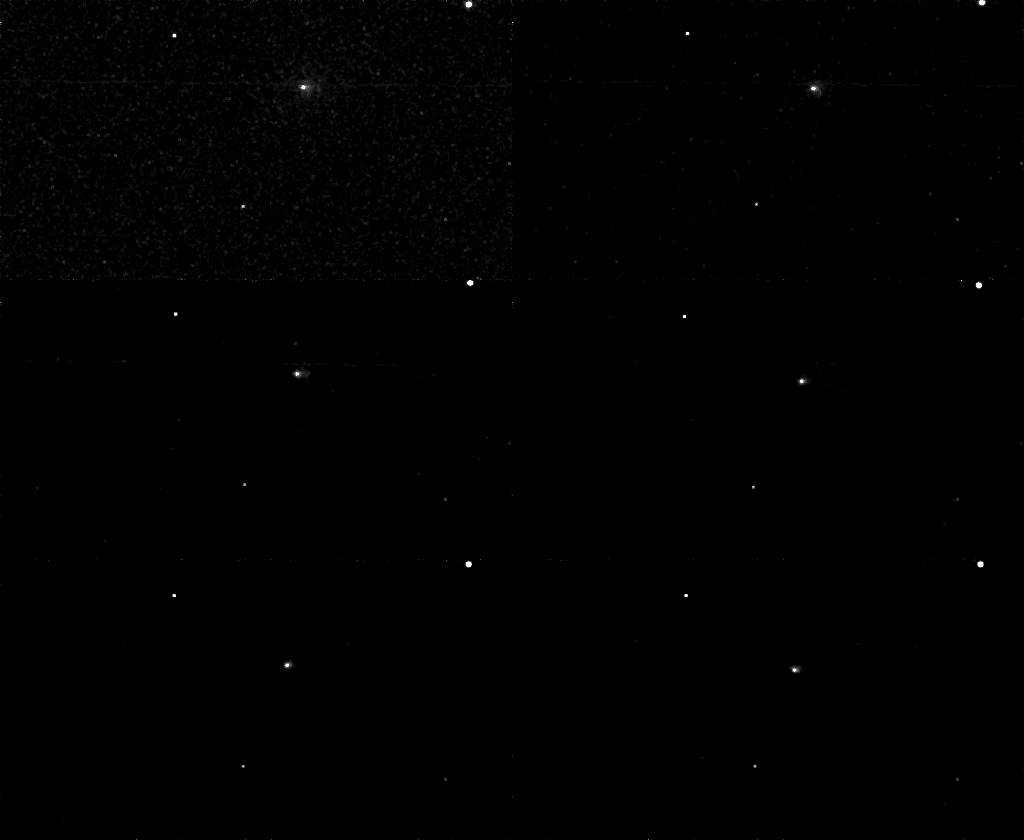
A European Space Agency (ESA) Mars orbiter has captured what is believed to be teh closest view yet of the interstellar comet 3I/ATLAS, currently making a rare journey through our solar system. while NASA has limited public outreach due to the ongoing U.S. government shutdown, observations from orbiters and rovers continue, revealing new details about this ancient cosmic traveler.A raw image taken by NASA’s Perseverance rover’s Right Navigation Camera on October 4 shows a bright, streaking object consistent with the comet’s predicted location, as reported by Space.com.
This sighting is notable as 3I/ATLAS is only the third interstellar object ever confirmed - following 1I/’Oumuamua and 2I/Borisov – and appears to be the largest, estimated between 3 and 7 miles (5 to 11 km) in width. Its trajectory and speed suggest it has been wandering the galaxy for billions of years, potentially predating our sun. The current lack of official NASA confirmation is due to the government shutdown, but independent analysis supports the identification.
Currently beyond direct Earth observation as it travels on the far side of the sun, 3I/ATLAS will again become visible to ground-based telescopes in early December. Astronomers anticipate a close approach to Jupiter in March 2026 before the comet exits our solar system permanently. The ESA orbiter’s images, and those from Perseverance, provide a unique possibility to study an object originating from outside our solar system, offering insights into the composition and formation of planetary systems around other stars.
The comet’s immense size and ancient origins make it a valuable subject for research. Studying 3I/ATLAS could reveal clues about the building blocks of planets and the conditions present in the regions of space where other solar systems form. While the shutdown limits immediate analysis, the data collected will be crucial for future investigations into the origins of our solar system and the prevalence of interstellar objects throughout the galaxy.
