
Roman Telescope Shields Its Instruments for Deep Space Exploration
NASA Installs Crucial Sunshade Components
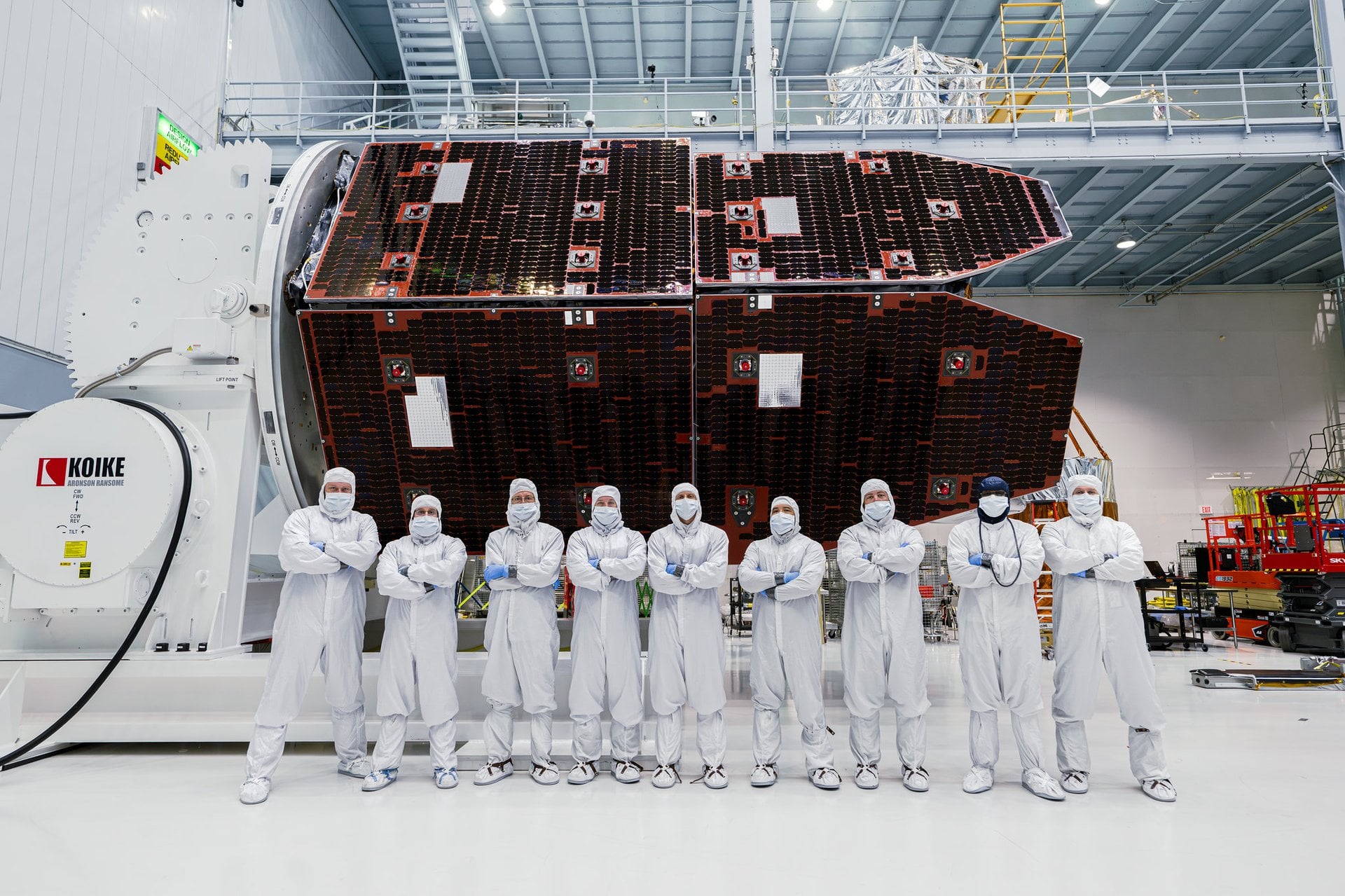
NASA’s Nancy Grace Roman Space Telescope is nearing assembly, with technicians recently completing the installation of its vital sunshade system, a critical step for its mission to probe the infrared universe.
Shielding the Observatory’s Core
Technicians at NASA’s Goddard Space Flight Center have successfully installed the final two panels for Roman’s Lower Instrument Sun Shade. This crucial component, alongside the telescope’s Solar Array Sun Shield and Deployable Aperture Cover, will shield its sensitive instruments from the Sun’s intense light and heat, enabling the detection of faint cosmic signals.
Innovative Design for a Powerful Telescope
Each sunshade panel, engineered at NASA Goddard, measures 2.1 meters in length and width and is 7.6 centimeters thick. These “giant aluminum sandwiches,” as described by aerospace engineer **Conrad Mason**, feature thin metal sheets with a stiff, lightweight honeycomb structure. Specialized polymer film blankets further regulate heat transfer.
Aerospace engineer **Matthew Stephens** elaborated on the shield’s function:
“This shield is like an extremely strong sunblock for Roman’s sensitive instruments, protecting them from heat and light from the Sun that would otherwise overwhelm our ability to detect faint signals from space. The deploying mechanisms have dampers that work like soft-close hinges for drawers or cabinets, so the panels won’t slam open and rattle the observatory. They each take about two minutes to move into their final positions. This is the very first system that Roman will deploy in space after the spacecraft separates from the launch vehicle.”
The Roman Space Telescope, named to honor NASA’s first Chief of Astronomy, **Nancy Grace Roman**, is slated for launch between Fall 2026 and May 2027. Its innovative design mirrors the protective measures of the James Webb Space Telescope, earning it the nickname “mother of the Hubble Space Telescope.”
The telescope’s inner segment is now undergoing a rigorous 70-day thermal vacuum test to simulate space conditions. The integration of the inner and outer segments is anticipated by November.
Unlocking Cosmic Mysteries
Once operational, Roman will investigate exoplanets, planet-forming disks, and distant galaxies. It aims to measure the universe’s expansion rate, contributing to our understanding of Dark Matter, Dark Energy, and the “Hubble Tension.” This ambitious mission is expected to illuminate some of astronomy’s most profound questions.
For context, the James Webb Space Telescope, a predecessor in deep space infrared observation, has already delivered stunning images of galaxies formed within the first billion years after the Big Bang, demonstrating the power of such advanced observatories. (Source: NASA, 2024).
