
Massachusetts lawmakers React to US Strikes on Iranian Nuclear Sites
Table of Contents
Following United States military strikes on three Iranian nuclear facilities on Saturday, Massachusetts lawmakers have issued varied responses, reflecting deep divisions over the action’s legality and potential consequences. The strikes have ignited debate across the state, from Beacon Hill to the halls of Congress.
Senator Ed Markey, in an official statement, condemned the strikes as illegal and unconstitutional, emphasizing that Congressional approval was absent. He stated,”This attack was not approved by Congress and holds dangers for all Americans. The American people do not want another endless war in the Middle East,” advocating for a diplomatic resolution to prevent Iran from acquiring nuclear weapons.
Senator Elizabeth Warren,addressing a town hall in Pittsfield,echoed similar concerns,warning that President Trump’s actions were escalating the risk of war with Iran. In a video posted on X, she asserted the attacks were unconstitutional and pledged to fight against further military escalation, urging a Senate vote to prevent further conflict.
U.S. Representative Katherine Clark, the Democratic House Whip, reinforced the constitutional prerogative of Congress to declare war. She stated on X, “Trump’s unilateral decision to attack Iran is unauthorized and unconstitutional. In doing so, the President has exposed our military and diplomatic personnel in the region to the risk of further escalation.”
Did You Know? The last formal Congressional declaration of war was during World War II in 1941.
Contrasting these views, Massachusetts Republican Party Chair Amy Carnevale released a statement commending President Trump’s decision to use military force against Iran, reflecting a stark partisan divide on the issue.
The military action also resonated with local communities. Soheil Fathi, co-owner of la Saison bakery with locations in Cambridge and Charlestown, expressed his concerns. Fathi, who was born and raised in Iran, described the news as “frustrating and scary,” hoping for a diplomatic resolution. He added, “I don’t think no one is gonna benefit from this. Not Israeli people, not Iranian people, not even American people. No one’s gonna benefit from this.”
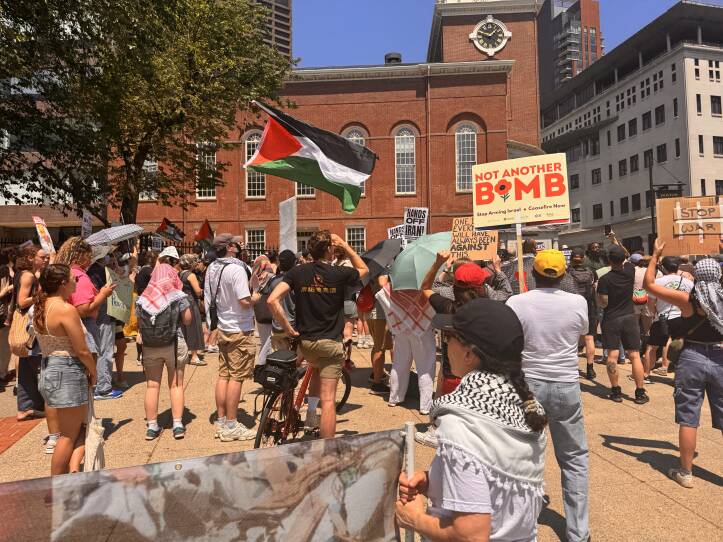
Public reaction in Boston included protests against the strikes, reflecting widespread anxiety over potential military escalation in the Middle East.
The debate over the legality of the strikes centers on the division of war powers between the executive and legislative branches. According to Article I, section 8 of the U.S. Constitution, Congress has the power to declare war. However, presidents have historically initiated military actions without formal declarations, citing the need for swift responses to perceived threats. This has led to ongoing legal and political disputes over the scope of presidential authority in foreign policy.
Pro Tip: Understanding the War Powers Resolution of 1973 can provide additional context to the legal arguments surrounding military actions initiated without Congressional approval.
Economic Impact of Middle east Conflict
Escalating tensions in the Middle East can have meaningful economic repercussions, notably on global energy markets. According to the U.S. Energy Information Management, the Strait of Hormuz, a narrow waterway between Oman and Iran, is a critical chokepoint through wich a significant percentage of the world’s oil supply passes. Disruptions in this region can lead to increased oil prices and broader economic instability [1].
Moreover,geopolitical instability can impact international trade,investment,and financial markets,affecting economies worldwide. The potential for increased military spending and humanitarian crises adds further strain to global resources.
US Military Spending Compared
The United States has consistently been among the top countries for military spending. Here’s a comparison of military expenditure by country in 2023, according to the Stockholm International Peace Research Institute (SIPRI):
| Country | Military Expenditure (USD Billions) |
|---|---|
| united States | 916 |
| China | 296 |
| Russia | 109 |
| India | 83.6 |
| Saudi Arabia | 75.8 |
Source: SIPRI
What are your thoughts on the balance between military action and diplomatic solutions? How do you think these events will impact the upcoming elections?
evergreen Insights: Background, Context, Ancient trends
The historical context of U.S.-Iran relations is crucial for understanding the current situation. The 1953 Iranian coup,supported by the U.S.and the UK, which overthrew the democratically elected Prime Minister Mohammad mosaddegh, remains a significant point of contention. The 1979 Iranian revolution, which led to the establishment of an Islamic Republic, further strained relations. The Iran nuclear deal, officially known as the Joint Extensive Plan of Action (JCPOA), was an attempt to limit Iran’s nuclear program in exchange for sanctions relief. However, the U.S. withdrawal from the JCPOA in 2018 under President Trump reimposed sanctions, escalating tensions once again.
Frequently Asked Questions
- Why did the US strike nuclear facilities in Iran?
- The stated reasons for the strikes vary, but generally involve concerns over Iran’s nuclear program and regional stability.
- What is the constitutional basis for military action against Iran?
- The constitutional basis is debated, with some arguing presidential authority and others emphasizing Congress’s war declaration power.
- How might the strikes on Iran affect global oil prices?
- Strikes could disrupt oil supplies, possibly leading to increased prices and economic instability.
- What are the potential long-term consequences of the US military action?
- Long-term consequences could include further regional instability, increased military spending, and shifts in international alliances.
- How does the public in massachusetts view the strikes on Iran?
- Public opinion in massachusetts is divided, with some supporting the action and others protesting against it.
- What role does diplomacy play in resolving the conflict with Iran?
- Many officials and citizens advocate for diplomatic solutions to prevent further escalation and promote regional stability.
Disclaimer: This article provides news and analysis and should not be considered legal or financial advice.
Share your thoughts and join the conversation! Subscribe for more updates on global events.
