
Smart Glasses Auto-Adjust to Sharpen Vision
Finnish firm IXI develops eyewear with lenses that change on the fly
Imagine a single pair of glasses that corrects both near and far vision. Finnish eyewear firm IXI is developing tech-packed specs that could make that a reality, potentially impacting millions.
Key Innovation
IXI’s chief executive and co-founder, Niko Eiden, showcased frames with lenses containing liquid crystals that adapt their vision-correcting properties dynamically. These crystals rotate via an electrical field, allowing precise tuning. An integrated eye-tracker ensures the glasses meet the wearer’s immediate needs.
Eiden acknowledges the need for consumer appeal, noting that “We need to make our products actually look like existing eyewear.”
He wants users to avoid a cyborg-like appearance.
Growing Market
The eyewear tech market is poised for growth. As the global population ages, presbyopia—age-related difficulty focusing on close objects—is expected to become more prevalent. In fact, approximately 1.8 billion people worldwide experienced vision impairment in 2020, with this number projected to increase significantly in the coming years (WHO 2023).
Traditional bifocal lenses require wearers to shift their gaze through different lens regions. Varifocals offer smoother transitions; however, auto-focus lenses spontaneously adjust, accommodating changing eyesight.
Development Challenges
“The first lenses that we produced were horrible,”
admits Eiden. Early prototypes suffered from haziness and poor edge quality. Recent versions, however, demonstrate promising results in company trials, where participants read text and view distant objects to test the glasses’ responsiveness.
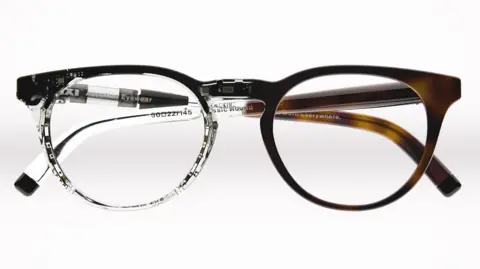
Emilia Helin, product director, emphasizes the importance of a proper fit. While IXI frames offer some adjustability, extensive modifications are limited due to the internal electronics. The company aims for a design that suits a wide range of faces.
The battery should last two days and can recharge overnight, according to Eiden. While a launch date is forthcoming later this year, Eiden remained coy about pricing, declining to confirm whether the glasses would cost around £1,000.
Expert Opinions
Paramdeep Bilkhu, clinical adviser at the College of Optometrists, believes that autofocus lenses could assist individuals struggling with varifocals or bifocals.
Chi-Ho To, an optometry researcher at the Hong Kong Polytechnic University, raised concerns about potential malfunctions during critical tasks like surgery. Nevertheless, he considers autofocusing a “good idea”
for general use.
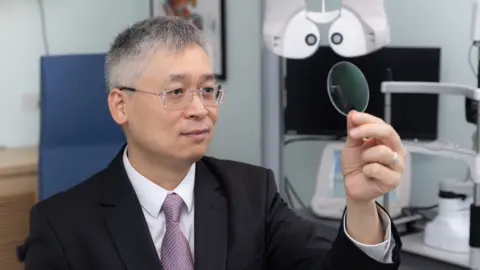
Eiden assures that initial versions will not adjust the entire lens area, allowing users to glance over the dynamic portion. Fully self-adjusting lenses would necessitate greater safety considerations.
Prior Attempts
In 2013, Adlens released glasses with manually adjustable lenses using a dial. Rob Stevens, Adlens’ current chief executive, reported positive consumer reception but limited optician support. Adlens continues to develop automatically refocusing lenses, but a launch date remains unconfirmed.
Joshua Silver, an Oxford University physicist and Adlens’ founder, created fluid-filled adjustable lenses in 1985, enabling affordable vision correction for approximately 100,000 people across 20 countries. He is now seeking investment for a venture called Vision, aimed at expanding the reach of these glasses.
Regarding high-tech auto-focus specs, Silver questions their mass appeal: “Wouldn’t [people] just go and buy reading glasses, which would more or less do the same thing for them?”

Slowing Myopia
Beyond mere correction, some specs tech can slow the progression of myopia. Prof To developed lenses with a honeycomb-like ring that defocuses light in the peripheral retina, reducing short-sightedness progression by 60%. These glasses are now available in over 30 countries.
SightGlass, a British firm, employs a different approach by subtly reducing visual contrast to impact eye growth. Prof To envisions glasses that could reverse myopia, potentially improving vision for billions.
“There is growing evidence that you can do it,”
teases Prof To.
