
Mysterious X-Ray Bursts: Trapped Jets Reveal Cosmic Secrets
Astronomers Pinpoint Source of Elusive Fast X-Ray Transients
Scientists have potentially solved the enigma of fast X-ray transients (FXTs), mysterious cosmic explosions that have long puzzled astronomers. New findings suggest these bursts originate from “failed” jets of high-energy particles trapped within supernova explosions.
Unlocking the FXT Puzzle
A coordinated effort involving ground-based and space telescopes has shed light on the nearest observed FXT, linked to the explosive demise of a massive star. Researchers identified a particle jet, or geyser, emanating from the supernova that produced the FXT. While jets escaping supernovas create powerful gamma-ray bursts (GRBs), those that become ensnared within the stellar layers emit lower-energy X-rays. This discovery bridges the gap between FXTs, GRBs, and supernovae, offering a more unified understanding of stellar death events.
The Einstein Probe’s Crucial Role
Decades of FXT detections were hampered by their rarity, limiting detailed study. The recent launch of the Einstein Probe in January 2024 by the Chinese Academy of Sciences, in partnership with the European Space Agency and the Max Planck Institute of Extraterrestrial Physics, has revolutionized FXT research. This new observatory is specifically designed to detect X-ray sources and quickly captured the closest FXT to date.
‘The Kangaroo’ Supernova Provides Key Data
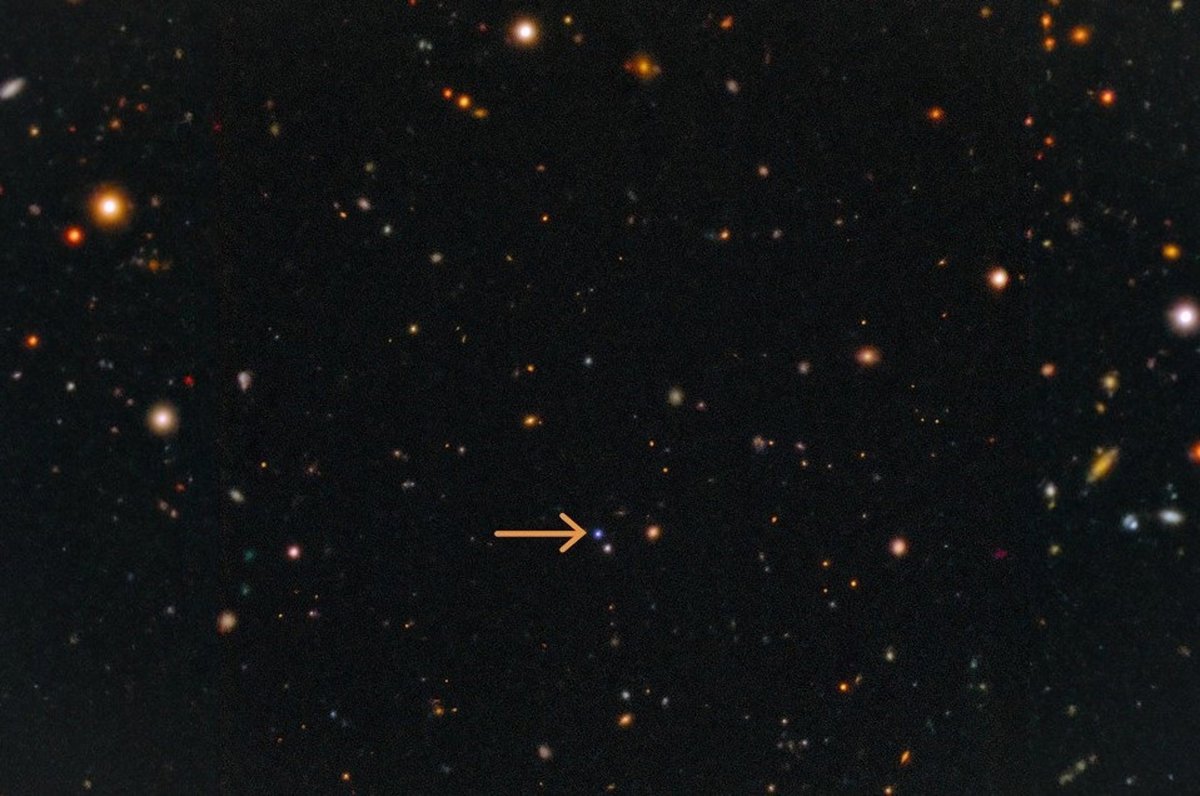
The FXT, designated EP 250108A, is located 2.8 billion light-years away in the constellation Eridanus. Its relative proximity provided an unparalleled chance to observe its evolution. Astronomers gathered data across multiple wavelengths using instruments like the Gemini South and Gemini North telescopes, the WM KECK Observatory, the MMT Observatory, and the James Webb Space Telescope (JWST).
“X-ray data alone does not indicate what phenomena originated a FXT,” stated **Rastinejad** in a communication. “The rapid observations of the location of the FXT in optical and infrared wavelengths are key to identifying the sequelae of an FXT and obtain clues about its origin.”
An Unexpected Discovery
Upon observing the aftermath of EP 250108A, astronomers detected the bright remnants of a supernova, nicknamed “the kangaroo” (officially SN 2025kg), which brightened for several weeks before fading. The JWST’s high-quality infrared spectra captured during the supernova’s peak revealed evidence of helium and carbon.
“I was surprised because we did not see Helio in any of our optical data, something that is not expected in this type of explosion,” explained **Charlie Kilpatrick**, Assistant Professor of Research at CIARA DE NORTHWESTERN and co-author of the studies. “However, this was a key clue that allowed us to determine that ‘the kangaroo’ came from a very massive star that probably had a partner before producing a FXT.”
Failed Jets and Massive Stars
While “the kangaroo” exhibited characteristics of a powerful Type Ic supernova, typically associated with GRBs, no evidence of a GRB was found. Instead, scientists concluded that EP 250108A was likely a “false” GRB, with its associated jets becoming trapped within the star rather than escaping. This suggests that massive star explosions can produce both FXTs and GRBs, with trapped jets potentially being more common than previously thought.
Research published in The Astrophysical Journal Letters details these findings. The parent star of EP 250108A is estimated to have had a mass between 15 and 30 times that of the Sun. The detailed observations, including those from the Southern Astrophysical Research Telescope, are helping to refine our understanding of these energetic cosmic events. For comparison, the most massive stars can be up to 150 times the mass of our Sun, according to NASA’s Goddard Space Flight Center (NASA).
