
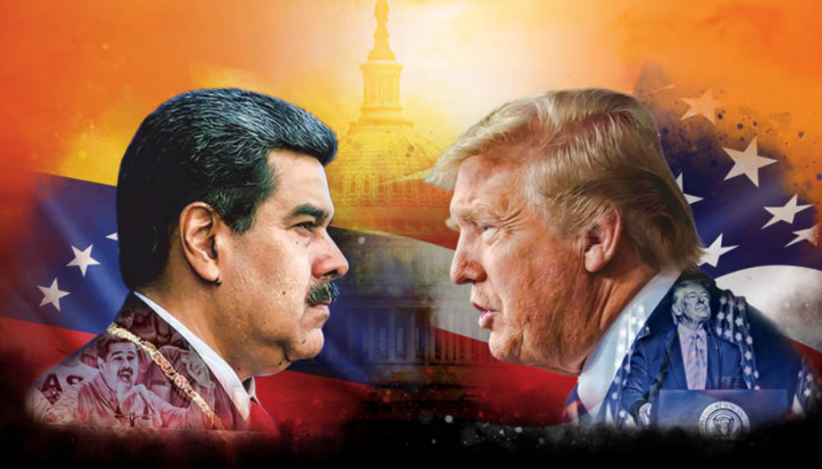
Trump‘s Rhetorical Framing of Venezuela: A strategy of Coercion and Control
Donald Trump’s November 17th address regarding Venezuela and its associated criminal organizations reveals a intentional rhetorical strategy designed to justify a perhaps escalated U.S.policy towards the nation. The speech, analyzed as a discursive framework, constructs a narrative that positions the U.S. as a force for regional stability while portraying the Maduro regime and linked criminal elements as a significant threat. This framing isn’t simply descriptive; it actively shapes perceptions and prepares domestic and international audiences for potential future actions.
A key element of the address was a clear distinction drawn between the Venezuelan people and their leadership. The speech explicitly identified the Maduro regime and associated criminal organizations as the source of instability, while simultaneously asserting a concern for the venezuelan population, framing them as distinct from the actions of their government. This separation is presented not as a matter of sentiment, but as a pragmatic approach allowing for pressure on the regime without alienating potential future allies within Venezuela. this echoes a historical pattern in U.S.foreign policy - condemning leadership while aiming to support the nation itself.
The language employed to describe these criminal elements was especially stark.Terms like “killers,” “massacre people,” and descriptions of extreme violence (“cut them into pieces”) were used, not merely to denounce the groups, but to amplify the perceived threat. This exaggeration serves to redefine the adversary, shifting the focus from political opposition to inherent destructiveness, thereby justifying a more forceful response than diplomatic or defensive measures alone.
Paradoxically, despite this harsh characterization, Trump stated a willingness to engage in dialog with Maduro: ”I would probably talk to Maduro.I talk to everyone.” This apparent contradiction isn’t a softening of stance, but rather a demonstration of power. The offer of dialogue is presented not as a search for common ground, but as a choice offered by the U.S. – punishment or negotiation, both controlled by washington. Negotiation, in this framework, isn’t a collaborative process, but an extension of U.S. influence.
This rhetorical construction establishes a moral framework, positioning the U.S. as the guarantor of regional stability and protection,while projecting chaos and threat onto the Venezuelan regime and its associated criminal networks. This framing serves to legitimize potentially harsher sanctions or increased interdictive actions,and prepares the public for a possible escalation of U.S. involvement in the caribbean region.
The core message conveyed is that the U.S. views itself as the architect of a return to stability, with Venezuela representing a systemic failure requiring containment or reconfiguration. The speech frames the border not simply as a geographical line, but as a “moral border” separating civilization from barbarism.
Ultimately, the November 17th address demonstrates that U.S. foreign policy is frequently enough less driven by emotion and more by the construction of narratives that justify the exercise of power. The speech articulated a specific understanding of the situation: the Maduro regime as the primary source of regional disorder, the U.S. as the restorer of stability, force and dialogue as complementary tools, and the border as a symbolic line of demarcation. This narrative serves not only to inform a domestic audience, but to lay the groundwork for future U.S.actions, positioning Venezuela as a key testing ground for the assertion of American order.
