
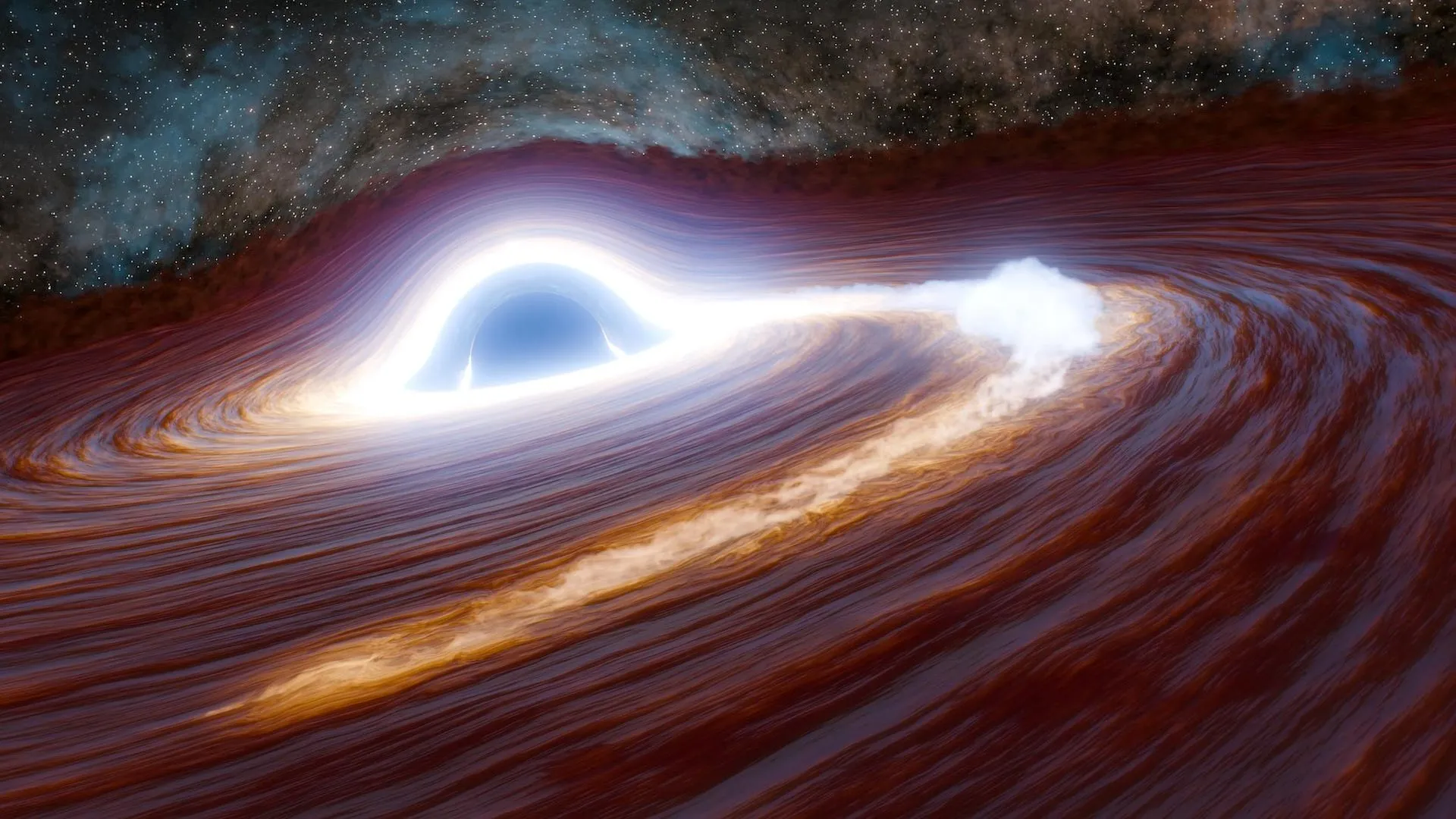
Unprecedented Black Hole Flare reveals Star’s Destructive Demise
Astronomers have identified the brightest flare ever recorded originating from a supermassive black hole, revealing a rare and powerful event: the ongoing disruption of an exceptionally large star. The revelation, made possible by the Zwicky Transient Facility (ZTF), offers a unique glimpse into the extreme processes occurring around active galactic nuclei (AGN).
The object, designated J2245+3743, initially appeared as a shining flare in 2018. However, its true nature wasn’t understood until follow-up observations in 2023 revealed an unexpectedly persistent and extreme luminosity. Initial spectra taken with the 200-inch Hale Telescope at Palomar Observatory showed no unusual characteristics,but the flare’s slow fade prompted further investigation using the W. M. Keck Observatory in Hawai’i, confirming its remarkable brightness.
Researchers meticulously ruled out alternative explanations for the flare’s intensity, including the possibility that the light was focused directly towards Earth. Data from NASA’s Wide-field Infrared Survey Explorer (WISE) mission eliminated this scenario,leading the team to conclude that J2245+3743 represents a record-breaking event. The energy released by the flare since its detection is equivalent to the total energy that would be produced if the Sun were entirely converted into energy, according to the equation E=mc².
The source of this immense energy is believed to be a tidal disruption event (TDE) – the process by which a black hole’s gravity overwhelms and tears apart a star. However, the scale of this TDE far exceeds typical events, ruling out a standard supernova as the cause. The researchers hypothesize that the star consumed by the black hole was unusually massive.
“Stars this massive are rare,” explained co-author K. E. Saavik Ford of the City University of New York (CUNY) Graduate Center, Borough of Manhattan Community College, and the American Museum of Natural History (AMNH). “But we think stars within the disk of an AGN can grow larger. The matter from the disk is dumped onto stars, causing them to grow in mass.”
The discovery highlights the potential for similar events to occur throughout the universe. The research team intends to analyze additional data from ZTF to identify further instances of these large TDEs. Future observatories, such as the Vera C. Rubin Observatory,are also expected to contribute to the search.
The study,”An Extremely Luminous Flare Recorded from a Supermassive Black Hole,” was supported by funding from the NSF,the Simons foundation,NASA,and the German Research Foundation. The research involved a collaborative effort from scientists at numerous institutions, including Caltech, CUNY, the Flatiron Institute, princeton University, Eureka Scientific, UC Berkeley, the University of Southampton, Ruhr University, and the University of Washington. Caltech’s ZTF is funded by the NSF and international partners, with additional support from the Heising-Simons Foundation and Caltech, and data processing is handled by Caltech’s IPAC astronomy center. NASA also supports ZTF’s search for near-Earth objects.
