
Telescopes Detect Rogue Planet Consuming Massive Amounts of Material, Blurring Line Between Planets and Stars
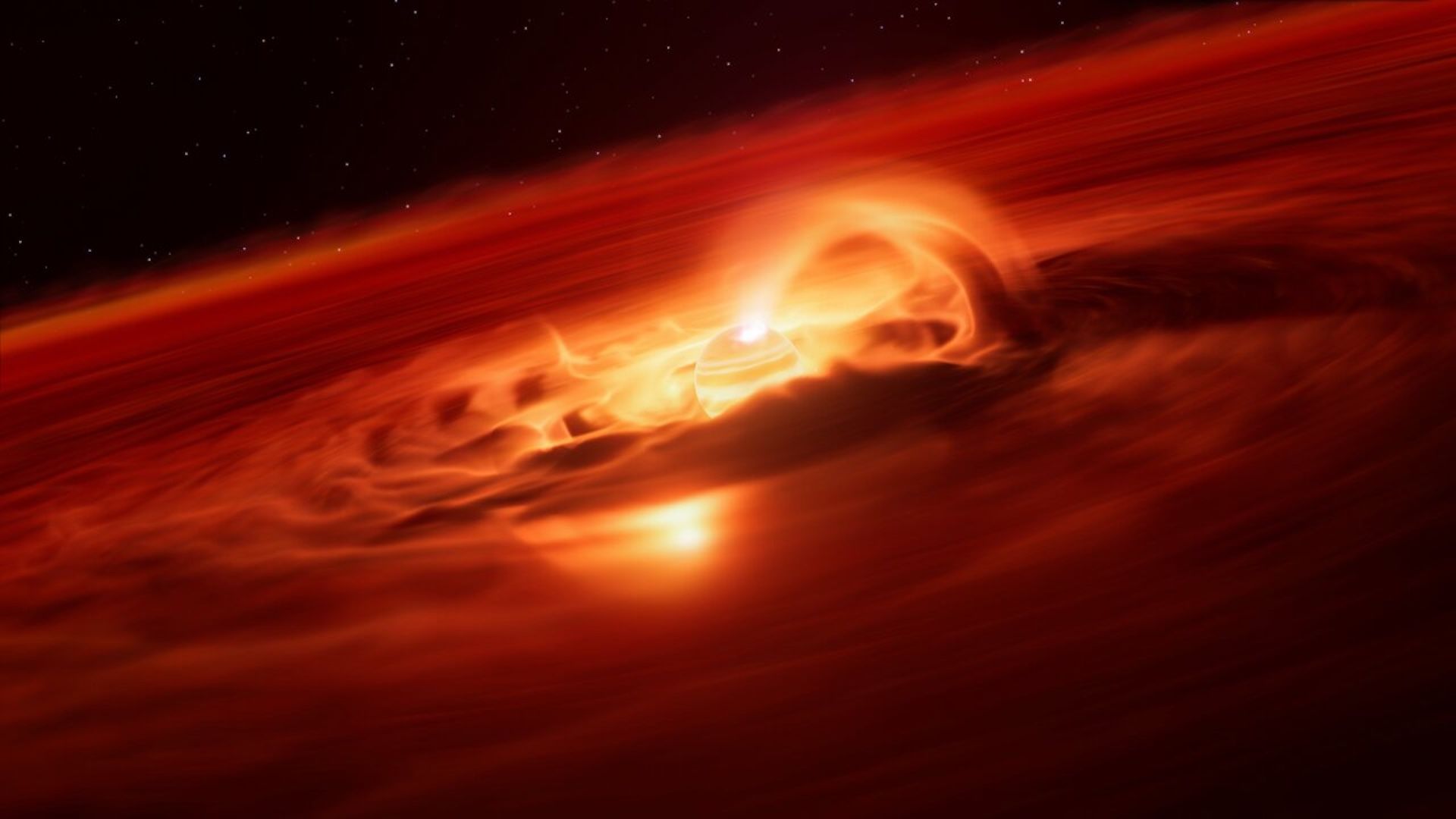
geneva, Switzerland – In a revelation challenging conventional understanding of planetary formation, the james Webb Space Telescope (JWST) and the European Southern Observatory’s Very Large Telescope (VLT) have observed a rogue planet, Cha 1107-7626, undergoing a dramatic accretion event, rapidly consuming approximately 6 billion tons of material per second. The findings, published recently, suggest this “runaway” planet is behaving more like a young star than a typical planet, offering clues to the origins of both celestial bodies.
Unlike planets within star systems that clear their orbital paths early in development, Cha 1107-7626, drifting freely in space, continues to accumulate mass at an remarkable rate.This ongoing accretion process,similar to how stars are born,is providing scientists with a unique opportunity to study planetary formation outside the influence of a star. “This is the first time we’ve seen a planetary-mass object undergoing such a dramatic accretion event,” explained Dr. Miriam Almendros-abad, a researcher involved in the study. “It’s blurring the lines between what we consider a planet and a star.”
The planet,located roughly 550 light-years away,was initially identified in 2004. Though, recent observations with JWST and VLT revealed the intense accretion burst, characterized by a significant increase in infrared radiation. This surge in energy is caused by material falling onto the planet, releasing heat as it impacts the surface. The discovery has implications for understanding the prevalence of similar events in the evolution of both planets and stars.
“The relics of such bursts might potentially be seen in the chemistry of meteorites in our own solar system,” stated Dr. Alexander Scholz, another researcher on the project. “It is not clear if bursts happen to all young stars, and what triggers them. The discovery of a similar event in a planetary-mass object may be a clue that there is a global mechanism behind accretion bursts. In this sense, our discovery will have a much wider impact.”
Scientists have recently identified numerous rogue planets, including over 500 discovered by JWST within the Orion Nebula. However, locating these objects remains challenging, as they emit primarily infrared light, requiring the power of telescopes like JWST and VLT for detection. Researchers plan to continue observing Cha 1107-7626 and other rogue planets to determine how common these accretion events are and to further investigate the similarities and differences in the formation processes of planets and stars. Understanding these processes could unlock fundamental insights into the origins of planetary systems throughout the universe.
