
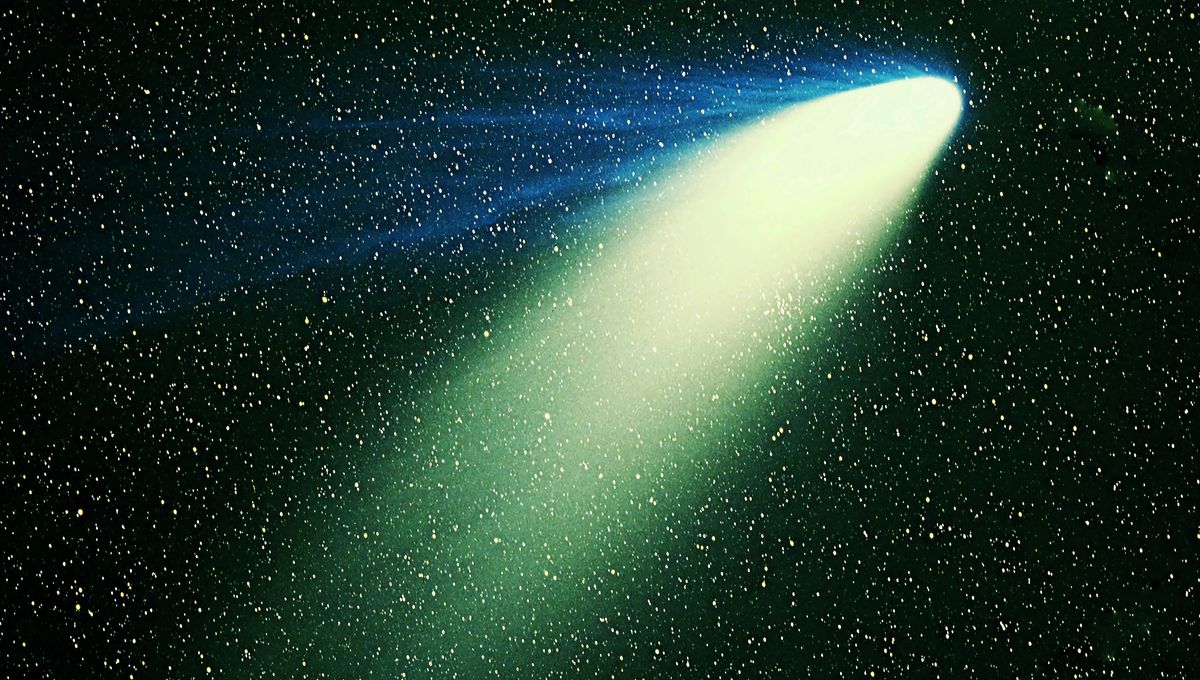
Interstellar Comet 3I/ATLAS displays Unexpected Green Hue, Puzzling Scientists
Namibian observations on September 7 revealed a striking color change in interstellar comet 3I/ATLAS, shifting from red to an unusual green with a blue tinge during a total lunar eclipse. Amateur astrophotographers Michael Jäger and Gerald Rhemann captured the images, noting a gas-rich coma measuring 2 arcminutes, clearly visible through both blue and green filters. “Our images show a gas-rich coma of 2 arcminutes for the first time. It was clearly visible in both the blue and green filters,” Jäger told SpaceWeather.com.
While green glows in comets are typically caused by diatomic carbon (C2) absorbing ultraviolet sunlight and emitting green light, 3I/ATLAS presents a mystery.Previous observations suggest the comet is “among the most carbon-chain depleted comets known,” indicating a low concentration of C2. This suggests the emerald color stems from an unidentified chemical process within the comet’s coma.
Harvard professor avi Loeb proposes a potential explanation, suggesting the color change may be linked to a meaningful increase in cyanide production, as observed by the European Southern Observatory’s Very large Telescope on August 25.
Beyond its color, 3I/ATLAS is notable for its size. A recent study by Loeb and colleagues Richard Cloete and Peter vereš estimates the comet’s mass at over 33 billion tons (33 trillion kilograms) with a nucleus diameter of 5 kilometers (3.1 miles)-exceptionally large for a comet.
Further observation is needed to understand the color shift and other anomalies. Viewing opportunities are limited; 3I/ATLAS will pass behind the Sun from late October 2025, becoming unobservable until early December 2025.
