
Ethereum’s Evolution: Sustainability, Scalability, adn a Growing Ecosystem
Ethereum has undergone significant evolution since “The Merge,” solidifying its position as a leading force in the cryptocurrency landscape.A key milestone was the April 2023 “Shanghai” update, which enabled users to withdraw their staked ETH, bolstering confidence in the network’s new Proof of Stake model and demonstrating its ability to offer versatility without compromising security.this growth spurred expansion within the Ethereum ecosystem, notably through Layer 2 solutions.
Networks like Arbitrum and optimism have gained prominence by providing faster and more efficient transactions, alleviating congestion on the main Ethereum chain. These Layer 2 solutions allow for the development and deployment of a growing number of decentralized applications - including exchanges and digital identity platforms – that benefit from Ethereum’s infrastructure without being hindered by its limitations. This is fostering a modular system where each layer serves a distinct function.
Beyond technical advancements, Ethereum has also strengthened its Environmental, Social, and Governance (ESG) profile. It has become a prime example of how a decentralized network can adapt to modern challenges,attracting attention from investment funds,regulators,and companies previously hesitant due to concerns about volatility and risk. This shift in perception has allowed Ethereum to maintain relevance in a competitive market with emerging blockchain technologies.
Today, Ethereum is more than just a cryptocurrency; it’s a dynamic platform undergoing continuous development.Its roadmap focuses on improvements in privacy, scalability, and governance. The merge marked a pivotal starting point, but the network’s journey is far from over.
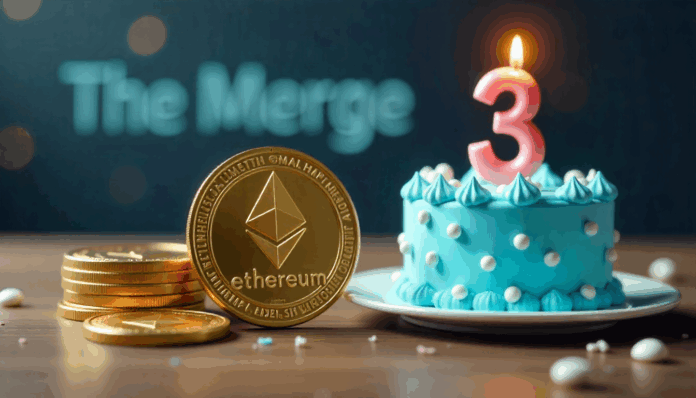
Three years after The Merge,Ethereum has established itself as a technical and ethical cornerstone of the crypto world. The transition to Proof of Stake wasn’t a step away from decentralization, but a necesary adaptation to address scalability and sustainability challenges inherent in a global infrastructure. While Bitcoin continues to demonstrate the security benefits of mining, Ethereum is pioneering new participation models that broaden access and prioritize environmental responsibility.
Ultimately, the diversity of technical approaches within blockchain networks – like the contrasting models of Bitcoin and Ethereum – strengthens the overall ecosystem. Different architectures allow each network to fulfill a specific role, whether as a store of value (bitcoin) or a platform for smart contracts (Ethereum).
