
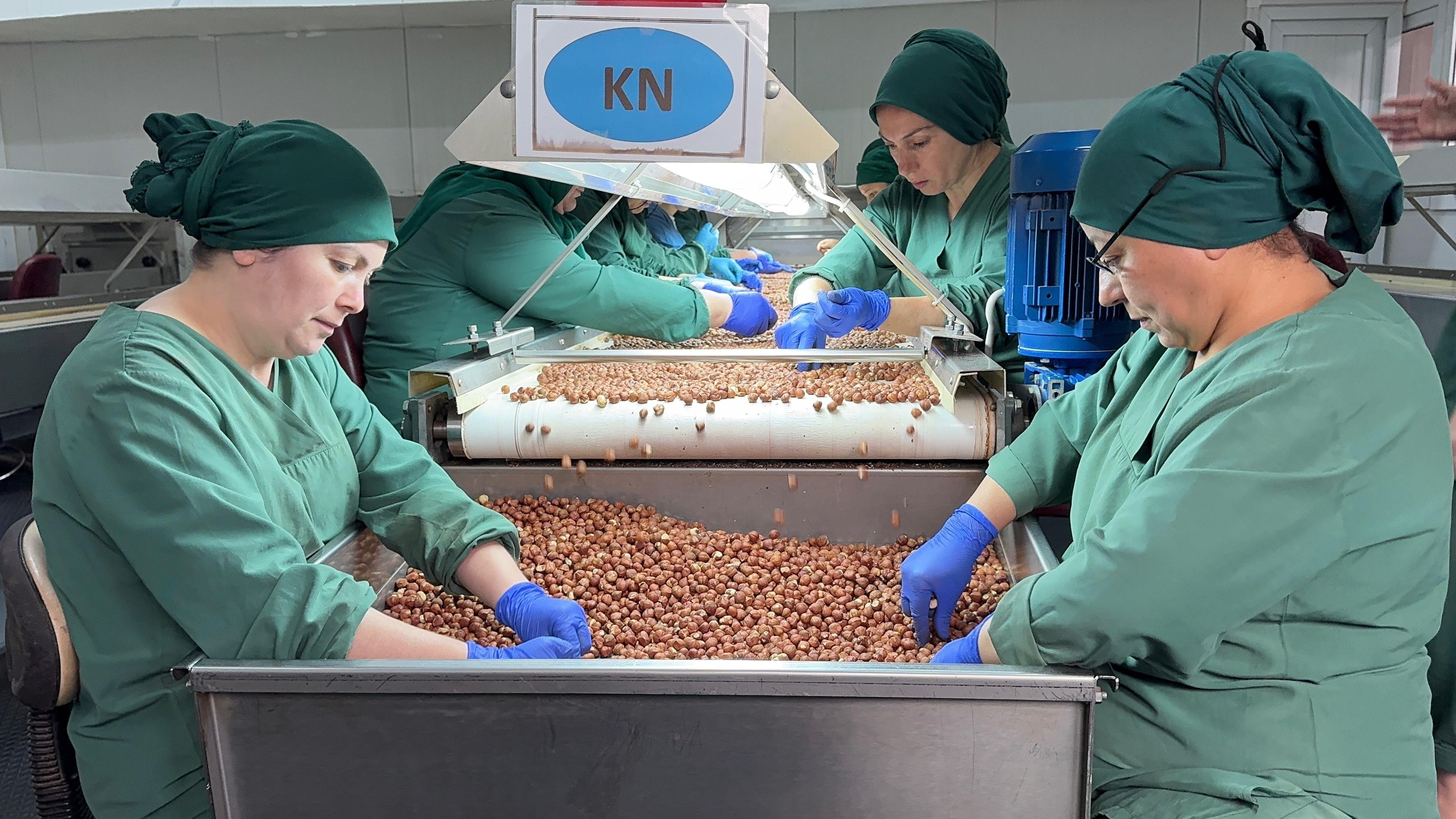
Turkish Hazelnut Exports Reach $2.56 Billion, Find Buyers in 124 Nations
ISTANBUL – Turkish hazelnut exports generated $2.558 billion (2,558,540,000 USD) during the 2024-2025 season (September 1, 2024 – August 31, 2025), according to data released by the General Secretariat of the Union of exporters of the Black Sea Hazelnuts and Products. This represents a rise from the previous season’s $2.349 billion (2,349,117,726 USD) earned from 303,458 tons of exports.
Germany, Italy, and France led as the top three importing countries. Germany accounted for $646.834 million (646,834,455 USD) from 79,723 tons, while Italy purchased 67,840 tons worth $570.996 million (570,996,436 USD). France’s imports totaled 16,757 tons, generating $137.575 million (137,575,156 USD).
Following closely were Poland, the netherlands, Switzerland, Spain, and Austria. Notably, the people’s Republic of China, Türkiye’s ninth-largest hazelnut importer, saw 8,551 tons exported, resulting in $79.430 million (79,430,964 USD) in revenue.
Hamza Bölük, President of the Giresun Commodity Exchange, emphasized the importance of diversifying export markets. “Türkiye’s export points are the same countries,” he stated, adding that initiatives are underway to identify and cultivate new opportunities. ”We ensure that the authorities of our member companies have face-to-face negotiations and commercial agreements with the companies in the countries we go to. We participate in trade fairs…We show the production and processing of hazelnuts by bringing the buyers in that country to our country.”
Bölük highlighted the notable potential in untapped markets like the USA, South America (specifically Brazil and Argentina), and the Far East (China, Japan, Korea, and India). “Traditional hazelnut exports…have reached the point of satisfaction or close. Hazelnut promotion is very significant. Our primary goal is to export to the countries of people who do not know hazelnuts,” he explained. “In the USA, as much hazelnut is not consumed. The US market is still empty.” He stressed the need to promote hazelnuts not only as a whole product but also as value-added items to boost consumption.
