
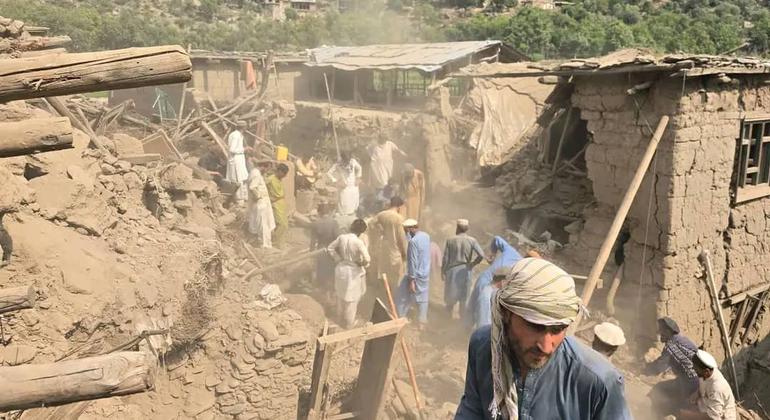
Afghanistan Earthquake: Rescue Efforts hampered by Remote Terrain, Dialog Issues, and Funding Shortages
Following a devastating earthquake in Afghanistan, rescue and relief operations are underway, facing notable challenges due to the region’s remote and rugged terrain, limited communication infrastructure, and a critical shortfall in humanitarian funding.
The earthquake has left communities largely isolated. Reports indicate that many affected areas remain inaccessible even by helicopter, hindering the delivery of aid and the search for survivors. Communication networks are severely disrupted, with limited cell service available only near a health center; the rest of the region is described as having “dark” connectivity.
The United Nations has responded by deploying at least 25 assessment teams to the impacted region and increasing flights via its humanitarian air service from Kabul. The UN Refugee Agency (UNHCR) is distributing essential supplies, including tents, blankets, and solar lamps, from pre-positioned stockpiles in Kabul. Priorities include providing emergency shelter, medical supplies, safe drinking water, and food assistance. Though, the delivery of medical aid is proving particularly tough, with supplies being transported “on foot” from the nearest UNICEF-supported hospital.Healthcare infrastructure has been damaged, forcing medical personnel at one centre in Ghazi Abad to treat patients “outside, under trees” due to fears of structural collapse. Thousands of local community members are actively participating in the search and rescue efforts,providing water and food to those in need.
Despite the urgent need, humanitarian operations are threatened by a significant funding gap. The UN World Food Program (WFP) warns it can only afford to provide food to earthquake victims for a limited time, insufficient to meet immediate needs or support long-term recovery. Of the $2.4 billion required for aid and development programs in Afghanistan this year, only $685.8 million has been received from donors, according to the UN aid coordination office, OCHA.
Afghan women are playing a crucial role as first responders, working long hours to reach affected women and girls. UN Women reports these workers are travelling on foot to provide direct assistance.However, the scale of the disaster means they are unable to reach everyone who requires help. UN Women emphasizes the importance of female humanitarian workers in overcoming cultural barriers that can hinder women’s access to aid, citing the disproportionate impact of the 2023 Herat earthquake on women – nearly six out of ten fatalities and two out of three injuries were women. The agency stresses that without female aid workers, many women and girls will be left without vital assistance.
