
Spacex Crew-10 Astronauts Return too Earth After Five-Month Mission
Table of Contents
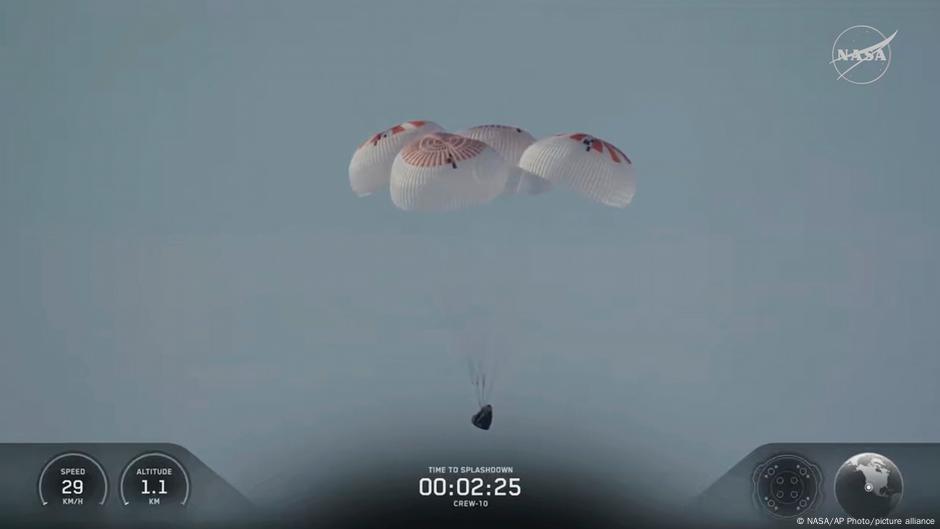
The four astronauts of the Spacex Crew-10 mission, in collaboration with NASA, successfully returned to Earth on Saturday, August 9, 2025. Their Dragon capsule splashed down off the coast of California at approximately 8:33 a.m. Pacific Time (15:33 GMT), marking the end of a nearly five-month stay aboard the International Space Station (ISS).
The return trip was extended to 18 hours after the crew decoupled from the ISS on Friday, which orbits 400 kilometers above Earth.They were replaced by the Crew-11 mission team.
Background: The International Space Station and Crewed Spaceflight
The International Space Station serves as a vital research laboratory in low Earth orbit, facilitating scientific experiments that advance our understanding of space and its effects on the human body. It is a collaborative project involving multiple space agencies, including NASA, Roscosmos (Russia), JAXA (Japan), and the European Space Agency (ESA).
Crewed missions to the ISS are essential for conducting long-duration research, maintaining the station’s functionality, and preparing for future space exploration endeavors, such as missions to the Moon and Mars. Spacex has become a key partner in these missions,providing transportation services through its Dragon spacecraft and Falcon 9 rocket.
This mission is part of NASA’s Commercial Crew Program, which aims to partner with private companies to provide reliable and cost-effective access to space. The program has significantly reduced reliance on foreign launch systems and expanded opportunities for scientific research in orbit.
Historical Trends in space Exploration
Human spaceflight has evolved significantly as the first human orbited Earth in 1961. Early missions focused on demonstrating the feasibility of space travel and achieving milestones like the Apollo Moon landings. In recent decades, the focus has shifted towards long-duration stays on the ISS, international collaboration, and the advancement of commercial space capabilities.
The ISS has been continuously inhabited since november 2000, providing a unique platform for research in various fields, including biology, physics, medicine, and Earth observation.The data collected from these experiments has contributed to advancements in numerous areas, benefiting life on Earth.
Frequently Asked Questions
- What was the primary purpose of the Crew-10 mission? The Crew-10 mission focused on conducting biomedical experiments and technological studies to prepare for future human exploration beyond low earth orbit and to benefit humanity.
- Who were the members of the Crew-10 team? The crew consisted of Commander Anne McClain and Pilot Nichole Ayers (both NASA), Mission Specialist Takuya Onishi (JAXA), and Cosmonaut Kirill Peskov (Roscosmos).
- How long did the crew-10 astronauts spend on the ISS? the astronauts spent 148 days aboard the International Space Station.
