
Lightning Sparks Greener Ammonia Production
Sydney researchers electrify the path to sustainable fertilizer.
Scientists at the University of Sydney have found a more efficient way to create ammonia, a critical ingredient in fertilizers, by using electricity to convert air directly into gaseous ammonia, potentially transforming global food production.
Key Development
The team, led by Professor PJ Cullen from the University of Sydney’s School of Chemical and Biomolecular Engineering and the Net Zero Institute, has been developing methods for ‘green ammonia’ production for six years.
“In this research we’ve successfully developed a method that allows air to be converted to ammonia in its gaseous form using electricity. A huge step towards our goals.”
said Cullen.
Unlike previous methods that produced ammonia in liquid solutions requiring additional energy, this new approach directly creates ammonia gas.
Notably, the shipping industry, responsible for approximately 3 percent of global greenhouse gas emissions, sees ammonia as a potential carbon-free fuel, aligning with global efforts to reduce emissions (IMO 2023).
Haber-Bosch Process Challenges
The traditional Haber-Bosch process, while revolutionary, is energy-intensive and carbon-heavy. It requires large-scale operations near cheap natural gas sources, contributing to a significant carbon footprint.
“Industry’s appetite for ammonia is only growing. For the past decade, the global scientific community, including our lab, wants to uncover a more sustainable way to produce ammonia that doesn’t rely on fossil fuels.
said Cullen.
The Haber-Bosch process currently accounts for 90 percent of global ammonia production, making it crucial to find greener alternatives.
Plasma Technology
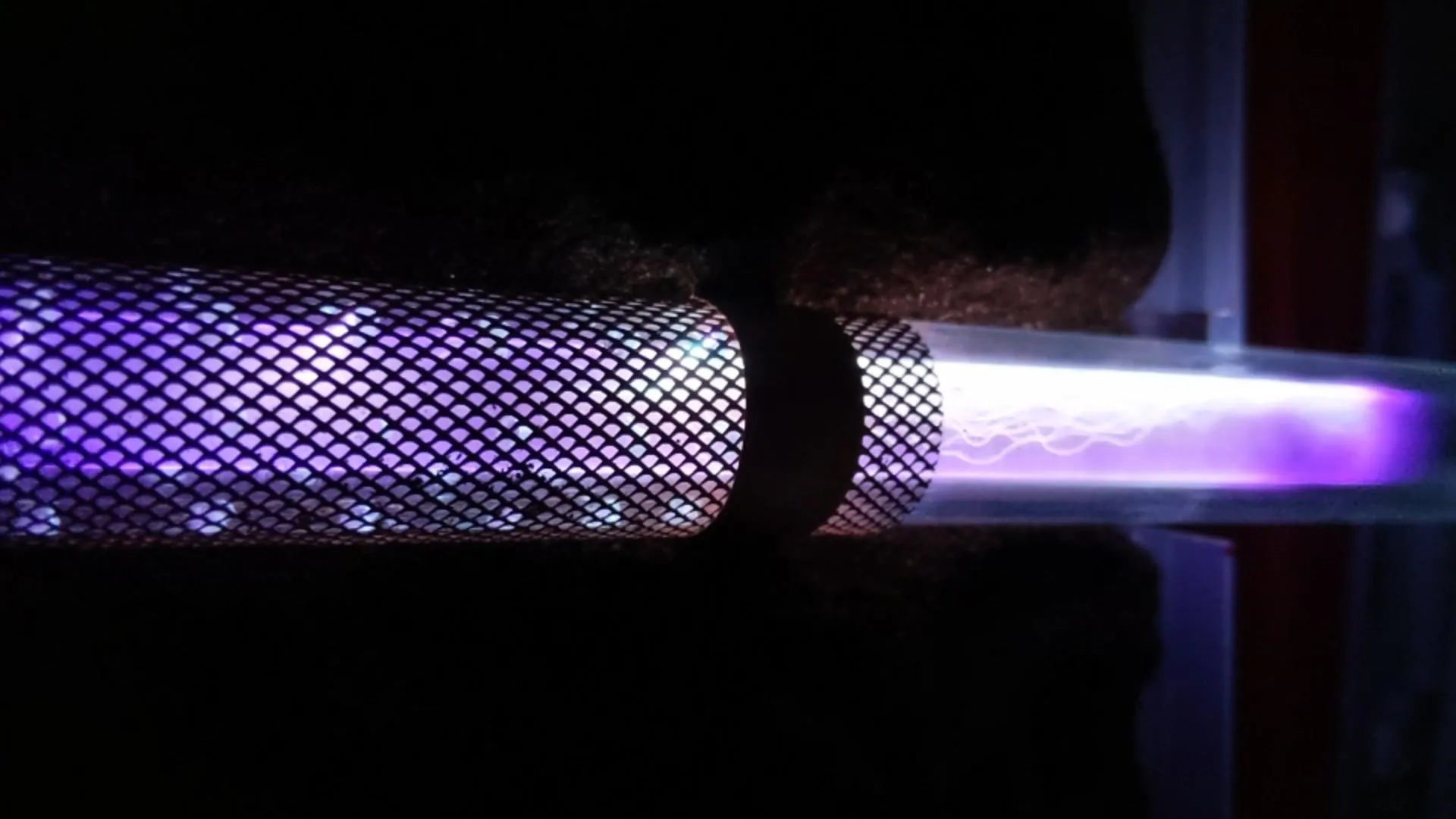
The new method developed by Cullen’s team employs plasma, generated by electrifying air, and a membrane-based electrolyser to convert the molecules into gaseous ammonia.
During the Haber-Bosch process, ammonia (NH3) is synthesized by combining nitrogen (N2) and hydrogen (H2) gases under intense heat and pressure, facilitated by a catalyst.
By using electricity to excite nitrogen and oxygen molecules in the air, the team streamlines the ammonia production pathway.
“Currently, generating ammonia requires centralized production and long-distance transportation of the product. We need a low-cost, decentralized and scalable ‘green ammonia’,”
said Cullen.
Next Steps
Cullen’s team is focused on enhancing the energy efficiency of their method to compete with the Haber-Bosch process.
“This new approach is a two-step process, namely combining plasma and electrolysis. We have already made the plasma component viable in terms of energy efficiency and scalability.
“To create a more complete solution to a sustainable ammonia productive, we need to push the energy efficiency of the electrolyzer component,”
Cullen said.
