
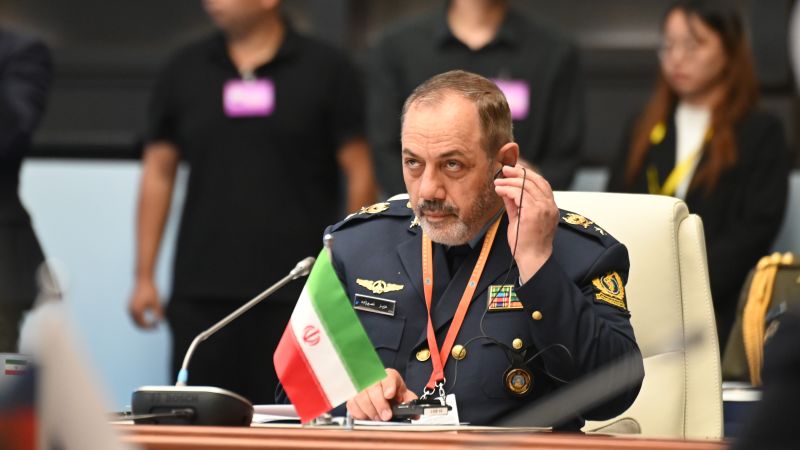
Iran Defense Minister’s China Trip Amid Regional Tensions
Meeting in Qingdao Highlights Growing Alliances
As regional tensions simmer, Iran’s defense minister, Aziz Nasirzadeh, made a trip to China. This visit comes after a recent, brief clash with Israel, underlining the complex geopolitical landscape and the strategic importance of the relationship between Iran and China.
China Hosts SCO Meeting
Nasirzadeh’s trip coincided with a meeting of the Shanghai Cooperation Organization (SCO) in Qingdao, China. The SCO, a regional security group led by China and Russia, aims to build alternative international blocs, and has become increasingly prominent.
The two-day gathering began Wednesday. A day earlier, a ceasefire had been reached between Iran and Israel. US strikes on three Iranian nuclear facilities punctuated the preceding aerial assaults.
The SCO meeting occurred concurrently with a NATO leaders’ gathering in The Hague. Donald Trump, the U.S. President, mentioned plans to meet with Iran regarding a possible nuclear agreement “next week.”
Beijing’s Strategic Role
Beijing, while largely remaining on the sidelines of the Iran-Israel conflict, highlighted its role as a major international player. For Iran, the visit underscored the importance of their relationship with Beijing.
Dong Jun, China’s Defense Minister, addressed the SCO gathering, presenting China’s vision for global security. He criticized the US by saying, “Unilateralism and protectionism are surging, while hegemonic, high-handed, and bullying acts severely undermine the international order, making these practices the biggest sources of chaos and harm.”
Dong advocated for SCO countries, including China, Russia, India, and Iran, to strengthen their coordination. He called on them to “defend international fairness and justice” and “uphold global strategic stability.”
According to China’s official news agency Xinhua, attending countries expressed a strong desire to expand military collaboration.
“Expressing gratitude to China for its understanding and support of Iran’s legitimate stance,”
— Xinhua
Nasirzadeh stated that he hopes China “will continue to uphold justice and play an even greater role in maintaining the current ceasefire and easing regional tensions.”
China’s Stance on the Conflict
China has condemned Israel’s June 13 attack on Iran, which took out top military leaders, as well as the subsequent US bombing. China has also backed a ceasefire and criticized Washington’s involvement, deeming it a “heavy blow to the international nuclear non-proliferation regime.”
Beijing has long opposed U.S. sanctions on Iran and criticized the U.S. withdrawal from the 2015 Iran nuclear deal. China remains a key diplomatic and economic backer of Iran, engaging in joint naval drills and deepening collaboration in recent years. A recent report by the U.S. Energy Information Administration states that China’s crude oil imports from Iran have surged, accounting for over 20% of China’s total crude oil imports. (EIA 2024)
Analysts suggest that in recent days, China has chosen to limit its involvement in the conflict to diplomatic efforts. China is positioning itself as a responsible global player while painting the US as a destabilizing force.
When questioned about potential material military support to Iran, ministry spokesman Zhang Xiaogang told CNN that “China is willing to work with all parties to play a constructive role in maintaining peace and stability in the Middle East.”
SCO’s Expansion and Challenges
Established in 2001 by China, Russia, Kazakhstan, Kyrgyzstan, Tajikistan, and Uzbekistan, the SCO seeks to counter the US alliance system. The group aims to maintain peace and stability in the region, though it faces challenges. These include overlapping interests and friction between member states, such as India and Pakistan.
Rajnath Singh, the Indian Defense Minister, was also present at the Qingdao meeting, marking the first visit from an Indian defense chief to China since a border clash in 2020.
The evolving relationships and alliances in the region remain complex.
